

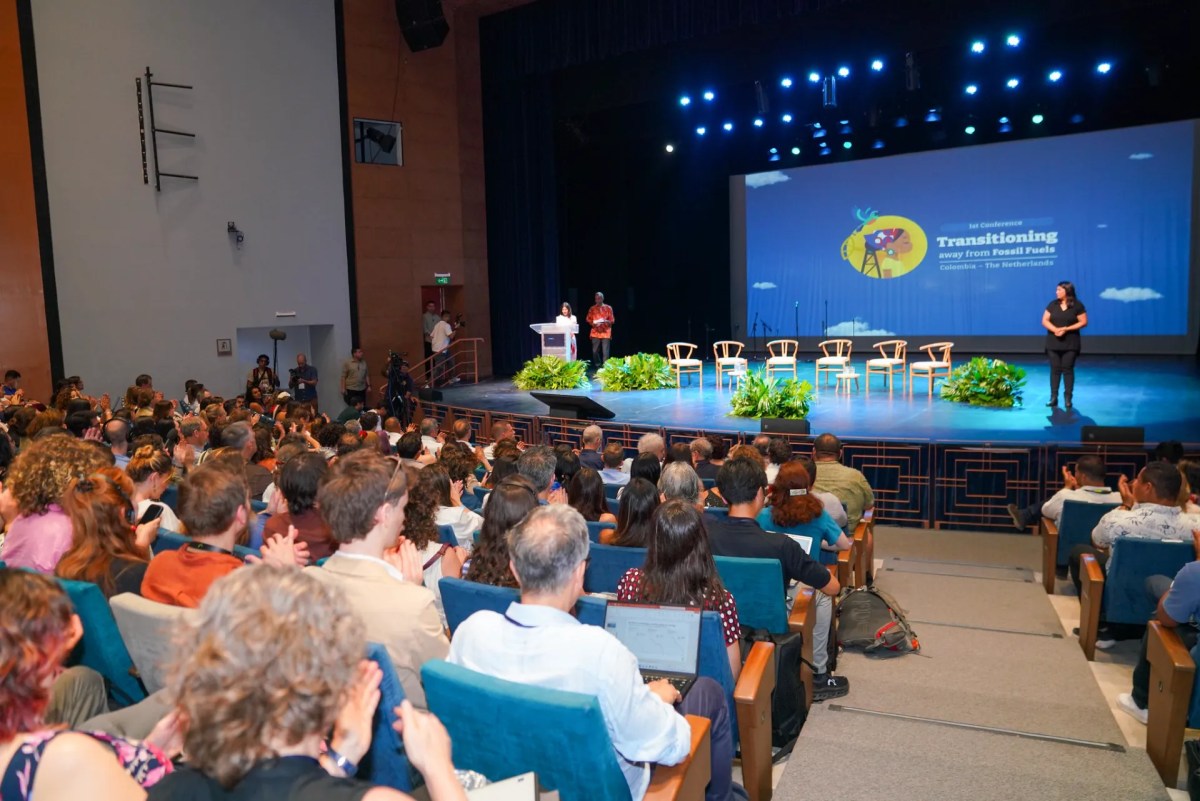
Conference in Colombia considers scientific knowledge as a core factor in guiding nations towards a fossil fuel-free economy; the initiatives announced this week will inform a final agreement among political leaders and create a permanent forum to assist in the implementation of practical actions.
“The energy transition is complex: it involves the economy, the environment, and social justice,” said Swedish scientist Johan Rockström, director of the Potsdam Institute for Climate Impact Research. The path towards the end of fossil fuels is not simple, but scientists willing to solve it are in Santa Marta, Colombia, at the First International Conference on Transitioning Away from Fossil Fuels, discussing the best way to move forward.
Two unprecedented efforts were presented in recent days and placed scientific knowledge at the center of the debates: the first effort was the academic cycle, which gathered some 300 experts from different countries at Magdalena University.
The group developed strategies for the energy transition, including concrete commitments to be presented to governments – a preliminary document with the result of the proposals summarizing the general lines of the recommendations. It will be presented to the countries this Tuesday (28) and Wednesday (29), when representatives of 56 nations will attend a high-level meeting to draw up implementation plans based, among others, on the evidence presented by the scientists.
The scientists’ proposal recommends halting new fossil fuel projects, reducing methane emissions, accelerating electrification, and ending subsidies to the oil industry. Among the arguments supporting these recommendations, the researchers highlight economic evidence pointing to the fast decline of the oil industry as well as practical examples of the expansion and use of renewable energies.
The second initiative is the creation of the Scientific Panel for the Global Energy Transition, a permanent body to advise governments, which will include 50-100 scientists to provide scientific evidence and produce recommendations aimed at guiding the fossil fuel phaseout.
The Scientific Panel will include names from international science and will be based at the State University of Campinas (Unicamp), in São Paulo state, Brazil. Conceived by Carlos Nobre, a world reference in global warming studies, the panel will be co-chaired by Johan Rockström and Unicamp Energy Systems Professor Gilberto Jannuzzi.

The launch of the panel filled the Santa Marta Theater at the Colombian university. Rockström stressed that, with the support of scientists, successful experiences and lessons learned by governments that have already begun their transition could “work as bridges between countries that are making faster progress and those that are still hesitant.”
The expectation is that the first results of the Scientific Panel will be presented at COP31, which will be held in Antalya, Turkey, in November 2026. “We are not here to establish a new scientific consensus; we are here to bring science together and enable better and faster decision-making in companies, countries and communities throughout the world,” Rockström said.
We are not here to establish a new scientific consensus; we are here to bring science together and enable better and faster decision-making in companies, countries and communities throughout the world.
Johan Rockström, director of the Potsdam Institute for Climate Impact Research
The Santa Marta Conference is scheduled to end on Wednesday with a high-level meeting of representatives of the participating countries. Throughout the event, the idea is to reclaim science’s leading role that has been undermined over the years at formal UN climate negotiations, frequently hampered by the fossil fuel industry’s lobby and geopolitical impasses between major oil producers.

Forest restoration as a complement to moving away from fossil fuels
“If we reach 2°C by 2050, many regions may become uninhabitable.” Carlos Nobre’s warning shows that we are already quite close to losing part of the planet – in 2025, the average annual temperature was about 1.43°C above the pre-industrial average (1850-1900), placing it between the second and third warmest years in the historical series.
In a conversation with journalists before the panel’s launch, Nobre stated that limiting global warming to 1.5°C will no longer be enough if goals are not turned into action. According to him, in addition to reducing emissions, large volumes of carbon will have to be removed from the atmosphere. He points to forest restoration as one of the main solutions.
“A positive way to do this is through forest restoration. The panel will also discuss how to avoid going beyond that limit and how to expand carbon removal,” said the climatologist, who also explained that the measure should compensate for some of the emissions already accumulated in the atmosphere. According to him, curbing deforestation in tropical forests is essential for avoiding irreversible scenarios.
“This is absolutely necessary because, if we go beyond forests’ tipping point, not only in the Amazon but also in other South American biomes such as Cerrado, Pantanal and semi-arid areas, we could release more than 400 billion tonnes of carbon dioxide. And that would make it impossible to meet the 1.5°C target,” he explained.
Scientists point to paths for the transition
“Sometimes you have to heat your pipelines […], compress your gas. We then ship it across the other side of the world […]. How ridiculously insane is this system that we built?,” said economist Mark Campanale. He is the CEO of Carbon Tracker, a think tank that conducts in-depth analyses on the impact of the financial market on climate risk.
Sometimes you have to heat your pipelines […], compress your gas. We then ship it across the other side of the world […]. How ridiculously insane is this system that we built?
Mark Campanale, CEO of Carbon Tracker
Campanale’s studies indicate that, in order to contain the planet’s fast warming, 80% of the still unexplored reserves of the fossil fuel industry must remain intact. He explains that the fossil energy system has already started structural decline. According to him, the economy based on oil, gas, and coal sustains approximately US$ 50 trillion in assets, including infrastructure, production, and consumption, but it faces accelerated disruption, driven by more efficient technologies.
The replacement occurs because the new energy system is simpler and cheaper, Campanale says. While the fossil model depends on long chains involving extraction, transportation, refining, and combustion – often in different parts of the planet – renewable energies can be generated with fewer steps and closer to their places of consumption.
This movement is already reflected in markets. According to him, global demand for oil peaked between 2019 and 2020, and projections indicate a drop of up to 8 million barrels per day by 2030, which tends to put pressure on prices and reduce the profitability of the industry.
“If everyone moves from an internal combustion engine leased car to an electric vehicle, we could be changing the whole system. […] [In Europe] EV sales, electric vehicles overtook petrol cars for the first time last year. This isn’t stopping. This is going faster with profound consequences for the fossil fuel system,” the economist stated.
In practice, this means that billions of dollars invested in fossil fuel infrastructure risk becoming stranded assets – a scenario that helps explain why industries resist the transition.
Zero emission is already a reality, says Chinese scientist
Along the same lines, researcher Pan Jiahua, from the Chinese Academy of Social Sciences, presented evidence showing that the transition is already underway, especially in China. The expansion of solar energy, combined with batteries and electric vehicles, already adds capacity equivalent to the total consumption of entire countries.
He says the debate needs to go beyond the idea of gradual “decarbonization” or an economy that is “low carbon” but still based on fossil fuels, and accept the need for a complete reconstruction of production systems. “A zero-emission economy is not a distant goal – it is already becoming a reality,” he stated.
“I don’t like the term decarbonization. You need carbon to decarbonize, and you can never eliminate carbon completely,” he said.
I don’t like the term decarbonization. You need carbon to decarbonize, and you can never eliminate carbon completely.
Pan Jiahua, from the Chinese Academy of Social Sciences
Despite acknowledging challenges, such as the demand for critical minerals, he argued that these resources are recyclable, unlike fossil fuels, where emissions are irreversible.
“In China, I visited several lithium battery recycling plants where 97% of the lithium is recoverable. I believe the same applies to recycling solar panels,” he stated.
Science recommends end to oil contracts
In the preliminary document presented at the academic cycle, scientists argue that the fossil fuel phaseout must include social justice, guaranteeing protection for workers and redistribution of costs and benefits, especially between countries of the Global North and South. The text also highlights the need to address so-called structural hurdles such as subsidies, contracts, and political interests, that maintain dependence on oil, gas, and coal.
The recommendations include halting new fossil fuel projects and creating economic mechanisms such as carbon pricing, and reorienting the financial system to reduce risks and increase investments in clean energy.
Another relevant theme is that of global governance. The researchers advocate greater international coordination, including the possibility of a specific legal instrument to regulate fossil fuel production, in addition to reviewing legal mechanisms that currently allow companies to sue states and delay climate policies.
Finally, the document stresses that the energy transition depends on effective social participation, with local communities, Indigenous Peoples, and workers being included in decision-making processes. The conclusion is straightforward: more than a technological shift, overcoming fossil fuels requires reorganizing the economic and political foundations that underpin the current model.
Opening image: Launch of the Scientific Panel for the Global Energy Transition at Teatro Santa Marta. Photo: Ministry of Environment of Colombia/Press release.
This report was produced with the support of the Global Greengrants Fund and the Climate and Land Use Alliance.