

Part of the Global South, including Brazil, argues that developed countries should move away from fossil fuels before others. For Martí Orta from the University of Barcelona, there is no room for different national paces when phasing out oil, gas, and coal. Furthermore, the researcher states that the opening of new exploration projects ignores the limits defined by science.
There is no more time for gradual transitions or for each country to decide its own pace of change in the face of the climate crisis. The warning comes from University of Barcelona Professor Martí Orta, one of the researchers who contributed to the scientific recommendations made by the First International Conference on Transitioning Away From Fossil Fuels, in Santa Marta, Colombia.
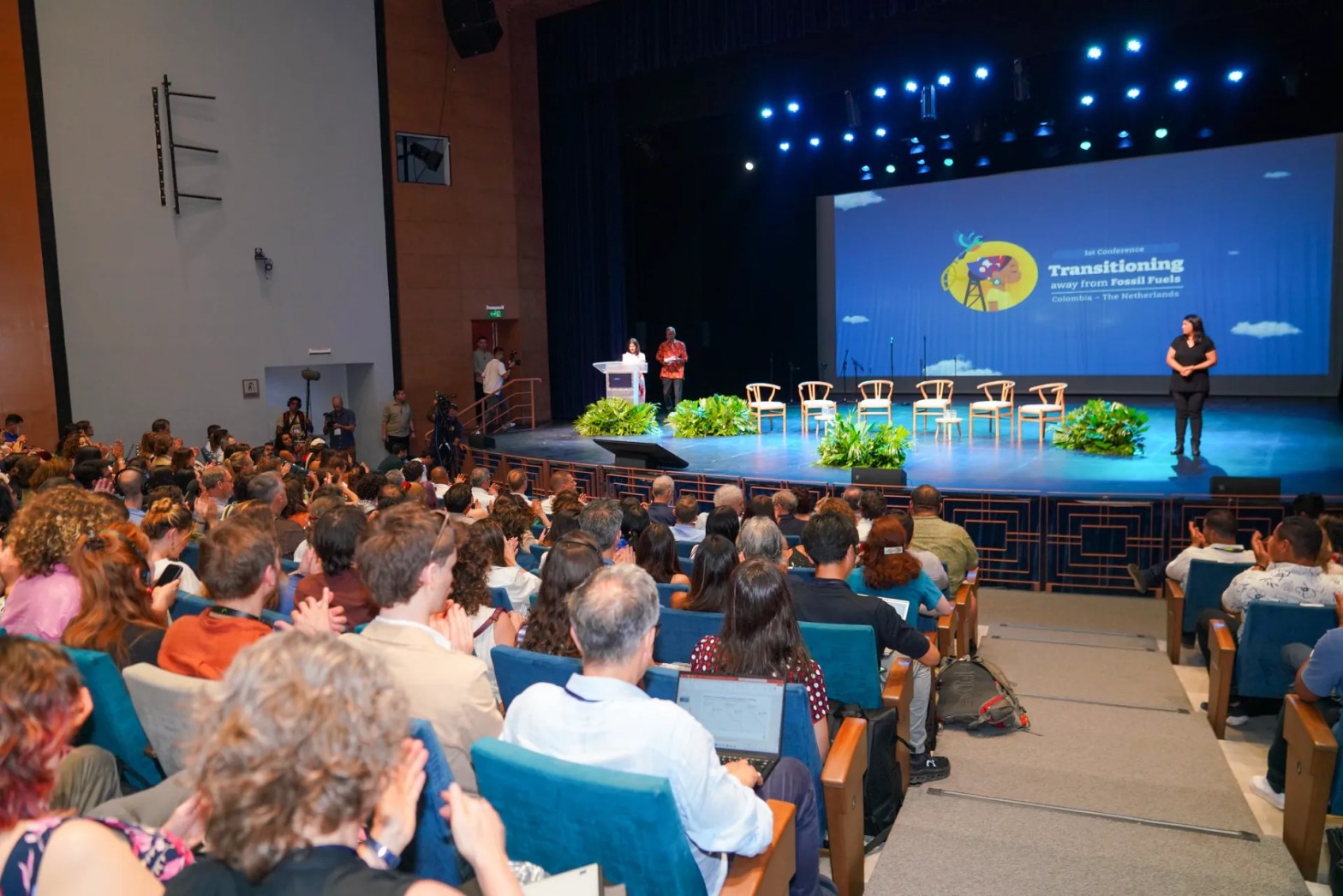
In recent days, along with some 300 scholars at Magdalena University in Santa Marta, Orta has devoted himself to creating a scientific proposal that will be presented to the governments of the 56 countries participating in the conference during the high-level meeting, which takes place this Tuesday (28) and Wednesday (29).
In an interview with InfoAmazonia, Orta anticipates a point of tension that pervades the international debate: the idea of an energy transition at different paces — advocated by countries of the Global South, such as Brazil – is not sustainable in the face of the climate urgency. “We don’t have time for that,” he says.
His view contradicts a study commissioned by the Brazilian government to inform its energy transition strategy. Prepared by the Catavento consultancy with support from the Brazilian Petroleum, Gas and Biofuels Institute (IBP) and the Climate and Society Institute (iCS), the study presents scenarios in which developed countries would be the first ones to move away from fossil fuel exploration, allowing developing nations to temporarily advance with new exploration fronts.
In practice, this approach opens up room for expanding fossil fuel projects in sensitive regions such as the mouth of the Amazon river and the equatorial margin of the South Atlantic, where large reserves have been found in Guyana and Venezuela. The study was cited by the president of the 30th UN Climate Change Conference (COP30), André Corrêa do Lago, as a reference for the creation of a global transition roadmap that Brazil intends to present in the next climate negotiations.
According to Orta, however, this view ignores the physical limits of the climate system. He argues that the current oil and gas exploration contracts, already signed and in operation, are enough to push the planet beyond the levels considered safe for global warming: “We arrived too late to the fight against climate change,” he says. “It’s not enough to stop exploring or to gradually reduce it. We must cancel most of the existing contracts.”
His assessment exposes a mismatch between what science has been pointing out for decades and what is taking place in the political field. For him, the obstacle is economic rather than technical. The energy transition is hampered by a framework of interests that still supports the fossil fuel model, despite growing evidence of climate collapse.

Trillions of dollars are at stake. According to Orta, the potential losses for oil and gas companies help explain the resistance of the industry, which has gone from denying the climate crisis to blocking public policies over the past few decades and is now working to delay the transition.
In this scenario, intermediate proposals such as keeping exploration with compensatory measures or adopting gradual reduction are seen as incompatible with the climate reality: “There is strong scientific consensus on what needs to be done,” says the scientist. “What is lacking now is political will.”
Read the full interview below.
InfoAmazonia – After the first few days of the conference, what is the main progress achieved in concrete terms?
Martí Orta – The truth is that there has long been scientific consensus on the need to move away from fossil fuels and also on the policies that are needed for it. In these two days of intense work by the scientific community, based on this consensus, we identified a series of actions that translate into recommendations for the governments that will meet here in Santa Marta in the coming days. These recommendations point out ways to implement this shift, which is urgent and necessary. We now have a well-structured list, and we hope to see which agreements will be adopted by the governments.
What do you think about this model in which scientists and academics meet to make recommendations for governments? Is it effective?
This consultative model has already been used in other multilateral forums such as COPs to discuss climate issues. I consider it absolutely necessary and essential. And with participation not only of the international scientific community but also other voices and knowledges from society. Here in Santa Marta, these knowledges were considered, and it seems that they will be heard by government officials in the coming days.
What are the differences between this conference model from other international initiatives?
The main difference is that the traditional multilateral forum, although essential – since it is where states meet to make decisions – has often been blocked by actors with heavy economic interests. This prevents progress in the direction that science has been pointing at for a long time: moving away from fossil fuels. Faced with this difficulty in advancing more forceful measures, the conference in Santa Marta will gather countries willing to adopt more ambitious, urgent and necessary measures to face this challenge, which is probably the greatest in the history of mankind.
Although we have nations here in Santa Marta that are willing to move away from fossil fuels, many internal issues remain. Some of these countries are even expanding their exploration. How do you see the political issue of implementing these recommendations?
These resistances exist and are very strong forces. They explain why mankind is lagging behind in facing the greatest challenge in its history, which is climate change. But it is also increasingly clear that we will all lose in this process. Of course there will be economic losses for producing countries if they implement climate measures, but if they do not implement them, the costs will be even greater.
It is also increasingly clear that we will all lose in this process. Of course there will be economic losses for producing countries if they implement climate measures, but if they do not implement them, the costs will be even greater.
Martí Orta, researcher at the University of Barcelona
The costs of climate action are high, but the costs of inaction are much higher. This includes, for example, the costs of adapting to the extreme weather events we are already facing, and that’s just the beginning. Emissions continue to increase. So, what we see today is not the final scenario, but only the start. The current costs are just the tip of the iceberg.
Could countries implement these recommendations at different paces, such as phasing out fossil fuels first in some of them?
What needs to be understood is that we don’t have time for these different levels of implementation. With the current oil and gas extraction contracts in the world – signed and legally binding, with wells, pipelines, and infrastructure already built – if these fossil fuels are exploited, we will not only exceed the 1.5°C limit but also far surpass 2°C in global warming.
This means activating feedback loops in the Earth’s climate system, that is, additional greenhouse gas emissions that worsen the problem. In other words: if we do not cancel 96% of existing oil and gas contracts, we will exceed 1.5°C. And, if we do not cancel at least 50%, we will exceed 2°C.
If we do not cancel 96% of existing oil and gas contracts, we will exceed 1.5°C. And, if we do not cancel at least 50%, we will exceed 2°C.
Martí Orta, researcher at the University of Barcelona
What does this mean? It means that it’s not enough to stop exploring. It’s not enough to stop expanding. Nor is it enough not to develop new reserves. The vast majority of existing extraction contracts must be canceled. The challenge is huge and needs to be addressed in less than ten years. At the current level of emissions, in a decade from now we’ll have released enough greenhouse gases into the atmosphere to exceed those 2°C.
Therefore, when the scientific community speaks of an emergency, it means a real emergency. There is no room for different paces. We must abandon fossil fuels immediately.
We arrived too late in the fight against climate change. The effects are already evident around the world – and this is just the beginning of what lies ahead.
The vast majority of existing extraction contracts must be canceled. The challenge is huge and needs to be addressed in less than ten years.
Martí Orta, pesquisador da Universidade de Barcelona
What practical measures have already proved to be feasible for this scenario?Some countries are moving fast in energy transition. This involves, for example, fiscal measures, cheaper electricity and higher taxes on fossil fuels to facilitate that transition. It also shows that we already have the capacity to produce clean energy at low costs in order to meet global demand.
If this is not happening yet, it is due to lack of political will related to strong economic pressures. We are talking about more than 40 trillion dollars at stake for oil and gas companies. That’s crazy. There is a lot of money at stake for these corporations, and all these pressures are normal.
These companies first tried to deny climate change. Then they tried to block climate action. Now, they are trying to postpone it. But this action is essential and urgent, and it must begin immediately by moving away from fossil fuels completely.
How can science influence political decisions more directly?
The truth is that science has done its part a long time ago. Now is the time for society as a whole to act: citizens, when making voting and consumption decisions, but also – and obviously – political representatives and companies that are responsible for our current situation. And not only companies but also financial entities and investors who continue to invest not only in extraction, but also in expanding the exploration frontier.
They [politicians, companies, investors] must take into account the existing evidence and have the courage to implement it. Investments are being made that may not have economic return, because putting these fossil fuels on the market is no longer feasible. The impact and climate consequences are so great and the economic costs are so high that it is impossible for this to continue.
What is needed is for those in positions of responsibility to be aware of the evidence we already have and implement decisions we all know: to stop investing in fossil fuels, which still offer higher profit margins, and start investing in alternative energies, even with lower immediate returns, but with a much higher return when all the impacts and economic costs of climate change are considered.
The transition should increase the demand for critical minerals. Do you believe this could result in new socio-environmental conflicts? How can we address them?
That’s not just a possibility. It’s already happening. Extraction of minerals critical to the energy transition is already creating impacts and conflicts. One way to deal with it is to reduce the use of these minerals in other sectors, such as the arms industry, and ensure that they are primarily directed towards the energy transition.
It is also necessary to change the way these minerals are extracted by adopting more rigorous standards and ensuring local communities’ participation to minimize environmental and social impacts.
The scientific community has already provided several guidelines on how this mining should be carried out: in an inclusive way with local communities and much more consciously regarding all the environmental and health impacts resulting from this extractive activity.
Are these issues being considered in the recommendations?
Yes, they are. The scientific conference discussed several topics, including this one. The recommendations cover different dimensions of that transition.
Do you believe that a consistent agreement between countries can emerge from this, such as a decision to stop exploration at some point?
It’s a dream, but at the same time, it’s something absolutely necessary and essential. I believe that this should be the starting point: that the government leaders and officials who will meet in the coming days are fully aware that this is a necessity rather than a choice.
There is an international legal context that makes this very difficult. We are well aware that international arbitration courts provided for in multilateral and bilateral free trade agreements make it difficult to cancel these exploration contracts. Companies could sue governments for alleged economic losses resulting from such cancellation.
It’s true that there are already many climate lawsuits against these companies and governments for the economic costs we are facing – and that we will all continue to face – costs that are far greater than the profits they can yield. Therefore, it is also necessary to annul these international arbitration courts, which are intended to protect investments in fossil fuels but end up condemning mankind to far greater economic costs due to climate change. We are aware of this. Changes are needed in these international arbitration mechanisms. This is necessary, and Colombia has already withdrawn from some of these international courts.
And this is one of the pillars of the transition. It’s not just about not expanding; it’s about canceling. Yes, it’s about ensuring that we will not extract half of the fossil fuels provided for in the contracts currently in force so as not to exceed 2°C of global warming.
This should not be done simply by changing these international rules. Importing countries must also help in this process by making massive investments to ensure that they no longer need to import fossil fuels and sending a very clear message: even if the contracts are canceled, these governments should not be sued, as companies will not be able to claim such large losses since there is no longer any purchase or demand for these fossil fuels.
Eighty percent of the world’s population who live in non-producing countries must send a clear signal that they no longer want to buy fossil fuels. That way, when these contracts are terminated, companies won’t lose money because there will be no intention to buy those barrels of fossil fuels – or tonnes of coal or cubic meters of gas that would be coming from those concessions, which [the companies] hold for 20, 30, 40 years.
Does that mean the problem is climate-related, but the solution could emerge from an economic perspective?
Well, let’s say it’s a problem we have and it affects many areas. It’s not just an environmental problem; it’s a health problem, an energy security problem, an economic problem. We saw this with the war in Iran: the countries that made progress in this energy transition fared much better in dealing with the increase in prices, the volatility in fossil fuel prices.
There are many aspects involved in the problem, and one of them is the economic one. If we continue emitting greenhouse gases, the economic consequences for industries and society will far outweigh the gains from continuing with the current fossil fuel-based model.
Opening image: Martí Orta, researcher at the University of Barcelona. Photo: Fábio Bispo/InfoAmazonia
This report was produced with the support of Global Greengrants Fund e da Climate and Land Use Alliance.