
From a geojournalism project launched at Rio+20 to a cross-border network of Amazonian journalists, we celebrate 14 years by reaffirming our commitment to journalism of the Amazon, for the Amazon, and from the Amazon.
At different moments in InfoAmazonia‘s history, a groan-worthy little joke has popped up in our editors’ and reporters’ feeds: someone was “trabalhando em rede” — literally, “working in a network.” In Portuguese, though, rede can mean both a network and a hammock. So the photo usually showed someone from the team smiling, stretched out in a good hammock, phone in hand, somewhere in the Amazon or traveling on a regional riverboat.
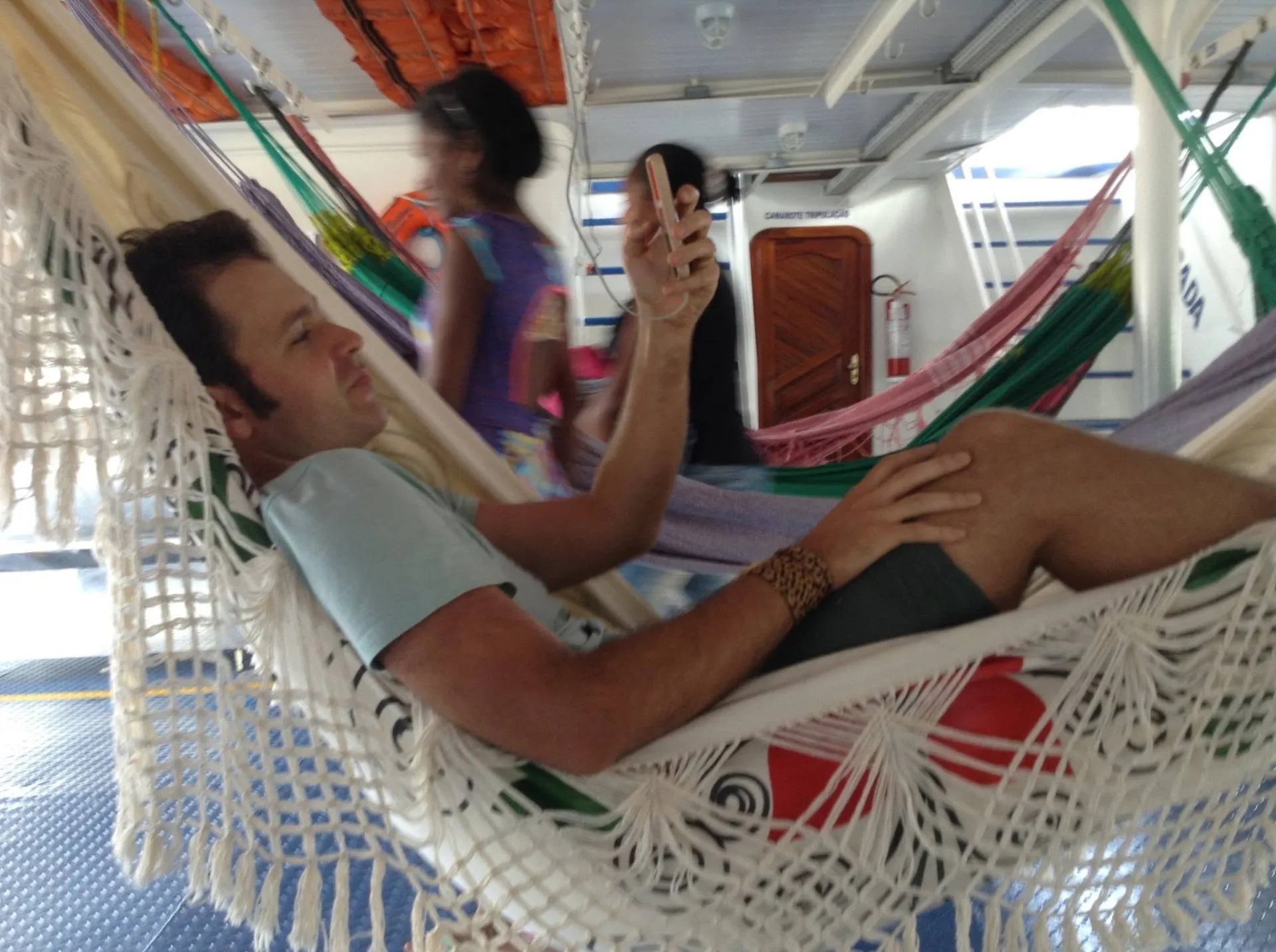
What started as a joke, though, has never made more sense than it does now. As we turn 14 this June 17, we celebrate what we love doing most: working as a network. We are renewing our commitment to a network of collaborators and media outlets across every state in the Brazilian Amazon and throughout the other Amazonian countries.
InfoAmazonia began in 2012, launched during Rio+20 as a special project of the website ((o))eco dedicated to bringing together maps, public information, and reporting on the Amazon. From the beginning, the idea was to connect geographic data with stories from Amazonian countries to deepen understanding of the region and its challenges.
The project grew. In 2020, we — Gustavo, Juliana, and Stefano — decided to create our own association and build a permanent team dedicated to producing content for the site. From that point on, InfoAmazonia was no longer only a data and reporting platform; it also became established as a journalism organization focused on the Amazon.
Soon after, in 2021, the Citizen Network was born: an alliance of regional journalism outlets focused on collaborative socio-environmental coverage. That collaboration led to award-winning investigations, including a story produced with the site Vocativo that revealed how illegal gold miners diverted medicines from SUS, Brazil’s public health system, meant for the Yanomami people. The alliance also produced a series on the Quilombola Amazon — traditional Afro-Brazilian communities — and another that mapped the people most vulnerable to extreme climate events in the region.
One of the most defining moments in this journey was the House of Socio-Environmental Journalism during COP30 in Belém, Brazil. There, we fulfilled the dream of collaboratively covering a historic moment, when the world’s eyes were on the Amazon — and when journalists from the region itself were able to claim space, provide context, and take a leading role in global coverage of the event.

Also last year, we launched Every Last Drop, an investigation built over more than a year by four outlets from Amazonian countries. The project offered a broad look at the environmental and social impacts of oil extraction in the Amazon in countries where fossil-fuel exploitation has been underway for decades — just as Brazil’s government was trying to authorize exploration at the mouth of the Amazon River.
Months later, as part of a global alliance that gave rise to the series Fueling Ecocide, we revealed the only active natural gas concession block inside a protected area of Brazil’s Legal Amazon. The collaborative, cross-border effort reached different audiences around the world and led to concrete results: recently, the company responsible for the block on Indigenous territory exposed by our investigation withdrew from the exploration project.
Our networked work also includes training. Through courses and workshops, we have trained — and learned from — hundreds of journalists; in 2024 alone, 359 people completed our 40-hour course on environmental investigative journalism and geojournalism.
When the first version of our site went live in 2012, there was a certain optimism in the air. Deforestation in the Amazon was at one of the lowest levels in the historical record, and Rio+20 strengthened the expectation that open data, transparency, and international cooperation could bolster democracy and environmental protection.
Since then, a lot has changed. Environmental policy has suffered setbacks in Brazil and in other countries. Contempt for democracy has led to more wars, authoritarianism, and disinformation. The slow response to the climate crisis has made the landscape harsher. COP30 itself, which for us was a milestone of collaboration among journalists from the Amazon, fell short of the urgency demanded by the climate crisis.
Even so, we have chosen to celebrate. Not because we ignore the challenges, but because turning 14 also means reaffirming our commitment to journalism of the Amazon, for the Amazon, and from the Amazon.
We celebrate because we remain convinced that many paths toward a better world will emerge from here: from the rivers, forests, cities, and territories of the Amazon. It is in the Amazon that history is being made every day.
For that, as we always say, one story will not be enough, nor will one reporter. We will need to gather many stories, data points, voices, and perspectives on this living map that is InfoAmazonia.
A living map in which the people behind it connect through fine but strong lines of collaboration. Lines that cross rivers, borders, newsrooms, communities, and territories, weaving a network: a journalism network, a network that sways with the rhythm of the Amazon, a network — like a hammock — that is a good place to work.