

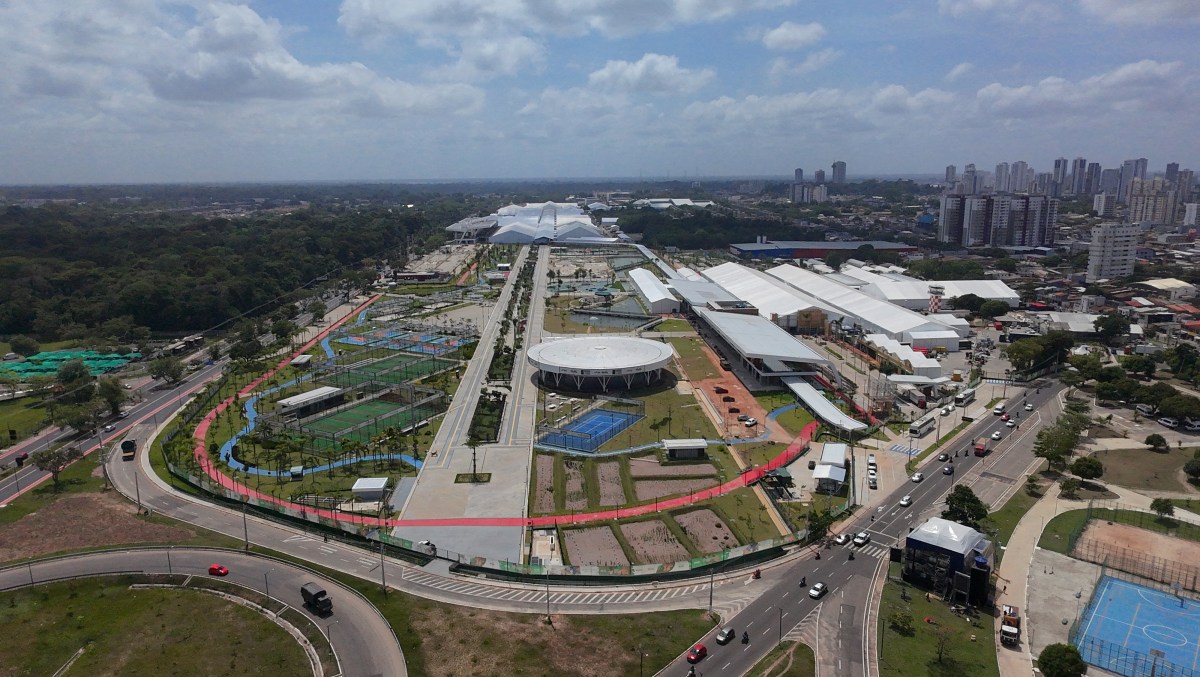
A mining company presents the ABC Norte REDD project as its environmental trump card, but the Brazilian Institute of Environment and Renewable Natural Resources found problems with timber extraction within the climate compensation area — which formed the basis of a complaint filed by the Public Prosecutor’s Office against the timber company Madeireira J & Y. The territory in the Amazon region of Pará also registers deforestation, authorization for mineral exploration, and land conflicts with traditional communities.
Presented by Vale as one of its main bets to offset its greenhouse gas emissions, the ABC Norte REDD project, by the Algar Group, is being developed in a territory in the Amazon with records of illegal logging and denounced by the Public Prosecutor’s Office of Pará.
The initiative, which takes place on the Pacajá Farm, between the municipalities of Portel and Bagre, in Pará state, promises to conserve 140,000 hectares of Amazon rainforest—almost the size of the city of São Paulo—and generate 1 million carbon credits per year until 2047. However, its real climate effects are hindered by environmental and land tenure irregularities. The farm has deforested areas, conflicts with traditional communities, suspended rural property registrations due to suspected land grabbing of public lands, and even mining permits for gold research and extraction.
In September of this year, the State Public Prosecutor’s Office filed a lawsuit with the judiciary based on an inspection by the Brazilian Institute of Environment and Renewable Natural Resources (IBAMA) that pointed out irregularities at the Pacajá Farm. The Sustainable Forest Management Plan (PMFS) being developed on the site was the target of Operation Custódia in November 2023, when inspectors identified at least four irregularities related to illegal logging.
In the complaint sent to the court, the Public Prosecutor’s Office points out that Madeireira J & Y, contracted to carry out the management, “used fraudulent artifices to forge non-existent forestry credits and issue public documents with false information, with the intention of concealing the illicit origin of the timber and giving the appearance of regularity to its commercialization and transportation.”
Madeireira J & Y was fined R$ 208,000 by IBAMA for exceeding the authorized volume of tree cutting and entering false information into the official control system. Furthermore, environmental inspectors stated that the company failed to trace the logs and generated waste. “These irregularities serve as elements that characterize the poor execution of forest management activities by the company,” concludes the inspection report obtained by the reporter.
IBAMA, at the time, seized logs without proper documentation of origin and identified trees with incorrect names. The wood from the most exploited species was entered into the system as belonging to other species, such as the taxi-pitomba — whose wood is used in furniture making and construction — which the company identified as jatobá or angelim-amargoso.
The complaint alleging irregularities in forest management in the ABC Norte REDD region seeks the conviction of Madeireira J.&Y for the crime of falsifying documents by inserting false data into public systems. The request from the Public Prosecutor’s Office was filed on September 8th and is still awaiting a decision from the court, which may accept or reject the complaint.

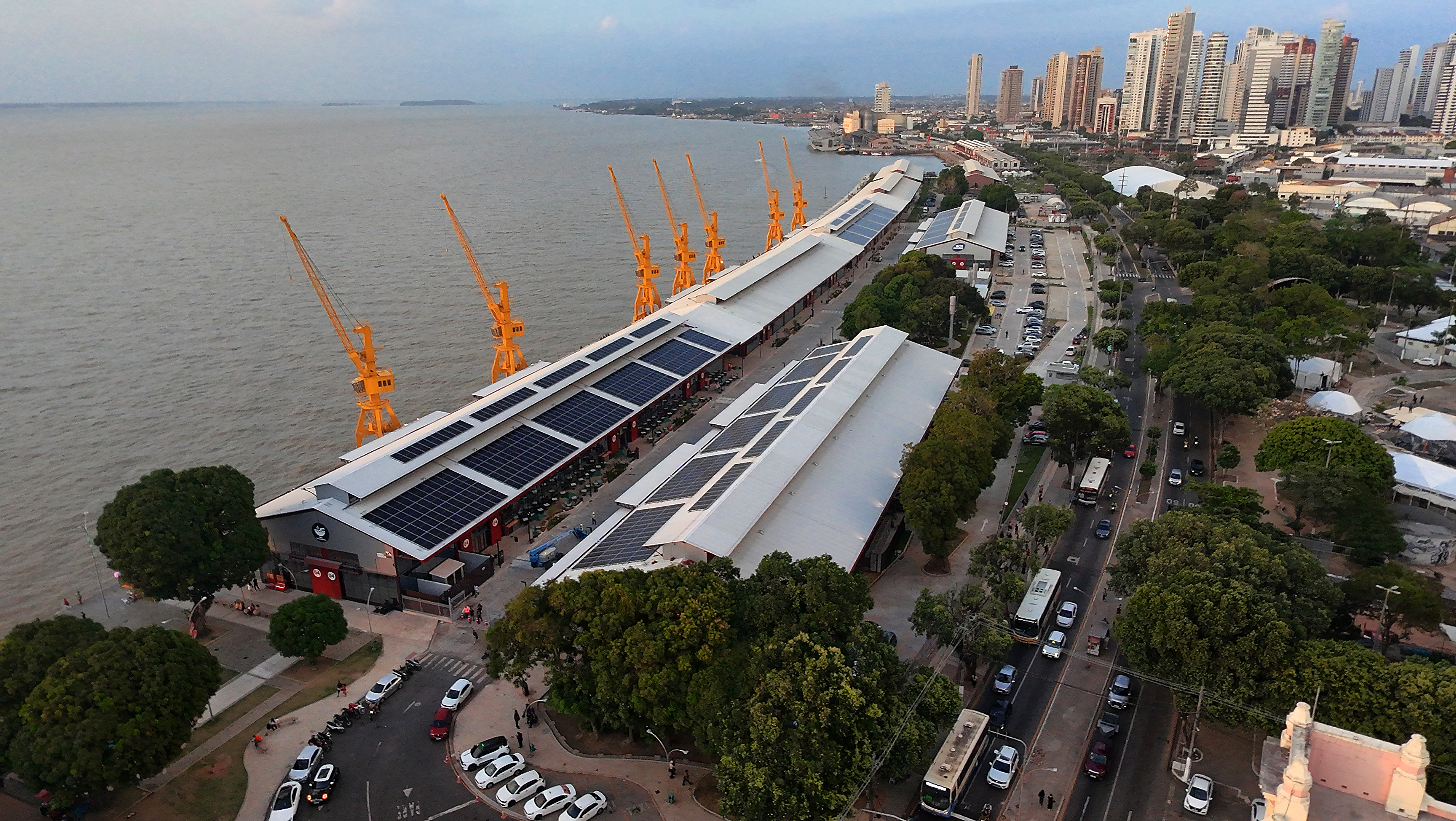

Despite the irregularities, Vale, one of the main sponsors of COP30—a global climate conference that begins next week in Belém (PA)—presented the partner project as an example of forest conservation within its carbon neutrality goals. In February 2023, nine months before the IBAMA inspection, the mining company announced the purchase of 133,000 credits from the ABC Norte project of the Algar Group, which would be equivalent to the protection of approximately 50,000 hectares of forest that year. The project contributed to the company’s claim of having achieved 50% of its forest protection target by 2030.
Vale: one of the main sponsors of COP30
The City Park, which will host the main events of COP30, is being built with approximately R$ 1 billion in environmental compensation from Vale, making it the most expensive project of the conference. The company also allocated resources from tax debts, such as the Mineral Resources Inspection Fee ( TFRM ), for the construction of Porto Futuro 2, amounting to around R$ 268 million.
The mining company has also increased investments to associate its image with the preservation of the Amazon, where 60% of its mineral exploration is concentrated. Through the Vale Cultural Institute and the Vale Foundation, the company sponsored major events such as The Town festival in São Paulo and Amazônia Live in Belém, which featured a concert by singer Mariah Carey.
When announcing the purchase of carbon credits from ABC Norte two years ago, Vale stated that “Pacajá Farm meets the legal requirements for sustainable management as an instrument for the conservation and preservation of native forests.” It further stated that all trees on the property are inventoried and georeferenced, which would guarantee traceability and transparency of the management. “The activity is based on low-impact forest harvesting, in addition to contributing to the sustainable use of the forest and keeping it standing,” concludes a note published on its website.
However, that is not exactly what IBAMA inspectors found on the farm, nor what satellite data analyzed by InfoAmazonia reveals. In the area of the farm where timber management is carried out, there was environmental degradation of more than 2,500 hectares of native forest in 2024, according to data from Imazon. Meanwhile, deforestation by clear-cutting on the Pacajá Farm — that which involves the complete extermination of vegetation — registered its highest peak in 2024 since 2017, the year in which the carbon credit preservation project began operating, according to analysis of satellite data from the National Institute for Space Research (INPE). Between 2017 and 2024, 341 hectares of deforestation were recorded in the farm area by the institute, with almost half of them (161.1 ha) within the carbon project area.Furthermore, the MapBiomas network monitoring system identified 46 deforestation alerts within the boundaries of the carbon project between 2019 and 2024, totaling approximately 115 hectares of felled forest. The logging occurred in a fragmented manner, with areas of up to 10 hectares, in isolated clearings within the forest — a pattern that, according to experts, increases the vulnerability of the Amazonian biome.
‘They claim to be green, but they are deforesting’
Residents of the Alto Rio Camapari region, in Portel (PA) — one of the communities located within the project area — claim that ABC Norte REDD is encroaching on territories traditionally occupied by riverside populations for generations (read more below). In these areas, logging has intensified again this year, as has deforestation. “They claim to be a green company, but they are deforesting here in the riverside communities’ areas. We had an agreement for them to respect our areas, but they are not complying,” said Francisco Rodrigues de Melo, known as Cametá, who presided over the Association of Agro-extractive Workers of Alto Camapari (Atagrocamp).
According to the community, the agreement stipulated that a 5,000-meter strip from the Camapari River would be for the exclusive use of the communities. In October, residents caught company employees inside the agreed-upon area, where logging was prohibited, as shown in a video obtained by the report. A meeting between residents and those responsible for the ABC Norte project is scheduled for November 8th.
According to researcher Marcela Vecchione Gonçalves, from the Center for Advanced Amazonian Studies at the Federal University of Pará (UFPA), the coexistence of projects with environmental impacts, such as logging and mining, with the generation of carbon credits is “environmentally and socially incompatible.” “Normally, degradation doesn’t appear as evidently as deforestation in REDD projects. But when it occurs in a management project that presents itself as sustainable, the result is what we call thinning of forest vegetation—a process that compromises the environmental integrity of the project and directly affects biodiversity,” she states.
Normally, degradation doesn’t appear as evidently as deforestation in REDD projects. But when it occurs in a management project that presents itself as sustainable, the result is what we call thinning of forest vegetation—a process that compromises the environmental integrity of the project and directly affects biodiversity.
Marcela Vecchione Gonçalves, from the Center for Advanced Amazonian Studies at the Federal University of Pará (UFPA)
Carbon credit resources are given to projects that — in theory — prove to reduce greenhouse gas emissions more than if the investment did not exist. Credits can come from avoided deforestation or changes in energy sources, for example. Each credit is equivalent to 1 ton of carbon that was not emitted. However, experts and researchers have questioned the effectiveness of carbon credit projects, and a recent study claims that the problems in the sector are systemic and persistent, not isolated cases (read more below).
Timber management plans are usually approved over long cycles, from ten to 35 years, precisely so that timber extraction is selective and organized in order to keep the forest standing. However, irregularities in the sector are frequent, such as the removal of trees in unauthorized areas, extraction in volumes exceeding the authorized limit, and fraud in the system, which opens the door to so-called “timber laundering”—when a log is removed from an illegal area but has false documentation attesting that it was removed from authorized territory.
A recent report from Imazon , based on data from the Timber Exploitation Monitoring System (Simex), reveals that 47% of the timber extracted in Pará in 2024 was of illegal origin.
Contacted by InfoAmazonia, Vale stated that the ABC Norte REDD project, from which it acquired carbon credits, was selected based on technical criteria and international standards, with the objective of “contributing to forest conservation.” The company declared that it “adopts rigorous risk assessment processes before establishing any partnership” and that all information available at the time was analyzed with “responsibility and transparency.”
“The forest management area is duly licensed, and activities follow the Sustainable Forest Management Plan (PMFS), with periodic inspections and reports approved by independent certification bodies. All clearings carried out by ABC Norte are duly licensed for management purposes, and any occurrences of illegal exploitation by third parties are promptly reported to the relevant authorities.”
When questioned about the complaint filed by the Public Prosecutor’s Office, the mining company said it is awaiting the judge’s decision on the case — read Vale’s full response .
When contacted, the Algar Group said it would not comment on the findings of the report.
InfoAmazonia attempted to contact Madeireira J & Y Ltda. by email, telephone, and through the Algar group’s press office, but received no response by the time of publication of this report.
Residents accuse ABC Norte company of land grabbing and invasion
Francisco Rodrigues de Melo presided over the Association of Agro-extractive Workers of Alto Camapari for years, but it wasn’t enough time to resolve the dispute that arose in the community with the arrival of logging companies in the late 1990s.
In 2007, following episodes of violence and threats against the community, riverside associations petitioned the courts to annul the property titles of the Pacajá Farm. According to local leaders, the dispute over the timber and the threats have never ceased.
After years of back-and-forth legal battles, a public civil action was initiated in 2015. In it, the Alto Camapari Association and the Portel Rural Workers Union questioned the validity of the land titles acquired by ABC Norte, accusing the use of front men in the distribution process of a large public area belonging to the Federal Government in 1979. In this accusation of land grabbing, residents claim that the area was divided into lots of up to 2,000 hectares, of which 52 land titles were subsequently acquired by ABC Norte, forming the 140,000 hectares of the Pacajá Farm.
Under the 1969 Constitution, in force at the time, the sale of public lands exceeding 3,000 hectares required approval from the National Congress — a limit that was reduced to 2,500 hectares in the 1988 Constitution. Since the distribution of public lands occurred in parcels smaller than 3,000 hectares, it did not have to go through Congress.
“They used front men to acquire this land without bidding and then transferred everything to their own name, completely ignoring the populations that already lived there,” stated lawyer Ismael Moraes, who represents the communities.In 2020, in the same public civil action, the Public Prosecutor’s Office of Pará (MPPA) informed the court that conflicts in the region had intensified again. According to the agency, based on complaints from the community, during the Amazonian summer of that year, ABC Norte allegedly increased logging with the support of militias formed by military police officers or individuals dressed as police officers and inspectors. The acts of violence reportedly occurred in the area where the communities accuse the company of land grabbing.
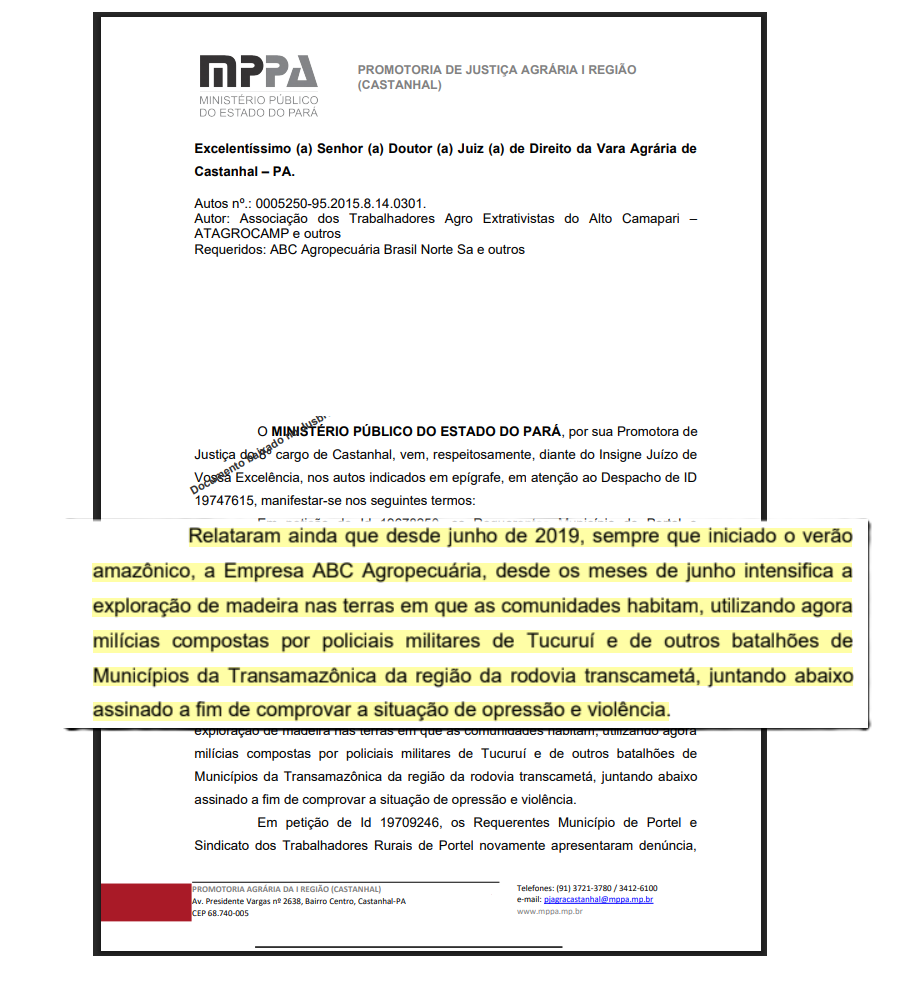
In court, ABC Norte, a company belonging to the Algar Group, denied the accusations and stated that it had contacted authorities to investigate timber theft on its land. The company described the accusations as “frivolous and unsubstantiated allegations.”
The Public Prosecutor’s Office requested a judicial inspection to investigate the allegations, but in June 2021, Judge André Luiz Filo-Creão Garcia da Fonseca decided to dismiss the case without a judgment on the merits — that is, without investigating the accusations of land grabbing and episodes of violence. In his decision, the judge points out that the associations failed to present documents for the contested rural properties, as required.
According to the extractivists’ defense, the registry office refused to provide the documents free of charge to the community. “It would cost around R$ 50,000 in deeds and documents, and the community didn’t have that money,” explained lawyer Ismael Moraes.
The Court of Justice of Pará acknowledged that the associations faced difficulties in obtaining the property certificates, but also upheld the decision to dismiss the complaint. In September, the residents’ associations filed a special appeal with the Superior Court of Justice (STJ) to overturn the decisions.
In addition to this legal action, another procedure initiated in the State’s Judicial Inspectorate preventively suspended two land registrations for the Pacajá Farm in September 2025, due to suspicion of illegal appropriation of public lands.
According to the public defender of Pará, Andreia Macedo Barreto, “when a land registration is blocked or canceled, it cannot be used in legal transactions; therefore, in these [carbon] projects, they shouldn’t even be certified or have their credits traded,” she stated to the reporter. The Public Defender’s Office of Pará requested the blocking of 600 land registrations in Portel, Breves, and Melgaço due to suspicions of land grabbing of public lands and obtained the cancellation of at least another 60 real estate registrations with suspected irregularities linked to areas developing carbon projects.
Companies question project calculations
The ABC Norte REDD carbon credit project was registered in 2023 by Verra, the world’s largest carbon credit certifier, based in the United States, and is authorized to trade offsets for forest preservation between 2017 and 2047.
The document approved by the certifying body acknowledges the existence of traditional communities within the project area. The company, however, claims to be the sole owner of the territory and says it maintains an informal usage agreement with the communities, “provided they commit to preserving the forest and do not leave environmental liabilities.”
Despite the certification, companies are questioning the calculations of the ABC Norte project, which has been criticized by the NBS Alliance, a coalition of 26 organizations from the carbon market itself. In a technical opinion sent to the certification company Verra and published on May 6, 2024, the alliance pointed out methodological flaws in the calculations of avoided deforestation, which could artificially inflate the volume of carbon credits issued.
Social scientist Fabrina Furtado, from the Federal Rural University of Rio de Janeiro (UFRRJ), who has been studying the impacts of REDD projects for over a decade, states that the mechanism “has structural flaws” and does not address the main causes of the climate crisis. “Its origin is flawed, based on the logic that the market will solve a problem that the market created. This mechanism will not combat climate change, nor will it reduce deforestation,” she laments.
Just weeks before COP30, a study analyzing 25 years of carbon credit projects, conducted by researchers from the universities of Oxford (UK) and Pennsylvania (USA), also concluded that the use of carbon credits has not proven effective in curbing climate change. The authors advocate for the gradual elimination of most credits, maintaining only those generated by the permanent removal of carbon dioxide from the atmosphere. Published in the journal Annual Review of Environment and Resources, the study points to structural flaws — such as non-additionality (credits without real emission reductions), impermanence (when stored carbon, as in forests, is released again due to fires or deforestation), among others. They also highlight cases of systematic market manipulation, where agents manage to circumvent the established rules, as another risk factor.
“We hope our findings serve as a warning ahead of COP 30: pointless offsets — which do not involve permanent carbon removal and storage — are a dangerous distraction from the real solution to the climate crisis: rapid and sustained cuts in emissions,” said lead author Joseph Romm in a statement about the research.
We hope our findings serve as a warning ahead of COP 30: pointless offsets — which do not involve permanent carbon removal and storage — are a dangerous distraction from the real solution to the climate crisis: rapid and sustained cuts in emissions.
Joseph Romm, researcher at the University of Pennsylvania
The study concludes that the failures of the carbon market are systemic and persistent, not isolated cases. According to the researchers, the current system cannot be corrected by specific adjustments, requiring a structural change in how the world accounts for and offsets its emissions.
When contacted, Verra stated that it would not be able to comment in the short term without analyzing the information gathered by the report. InfoAmazonia remains open to hearing the certification company’s position on the matter.

Mineral exploration
In addition to irregularities in forest management and criticism of the carbon project within the Pacajá Farm, there are also at least six mining applications overlapping the area. Four of these mining applications have authorization for gold exploration. In one of them, the start of mining activities was reported to the National Mining Agency (ANM) in 2022. In this area designated for mining, there are several points of deforestation identified by INPE.
Mineral exploration, the stage that studies the existence of minerals and their economic viability, is usually accompanied by deforestation to open roads for transporting drilling machinery. If economic viability is confirmed and exploration is authorized by the regulatory agency, environmental degradation increases exponentially, with the creation of mines, contamination of rivers, explosions, dust, and noise pollution.
In June, the news report consulted the ANM regarding cases of overlapping carbon projects with mining areas. In a statement, the agency informed that “there are currently no specific procedures requiring applicants for mining titles to consult beforehand about the existence of carbon projects in the intended areas, nor are there mechanisms for formal integration with carbon credit certification entities.” Finally, the agency justified that mining “is complex, but essential for the energy transition and the reduction of global emissions” and that the sector is “one of the production chains with the lowest carbon footprint in its primary operation.”
Researcher Vecchione points out that both mining and forest management can significantly increase degradation in the Amazon, which, in addition to emitting greenhouse gases, contributes significantly to the loss of the forest’s ecosystem services. “What kind of integrity of climate information is being conveyed with these projects? Carbon projects involving mining and forest management authorizations do not neutralize emissions,” she adds.
This report uses the database from the Carbono Opaco project, developed in partnership between InfoAmazonia , Ojo Público, and the Latin American Center for Investigative Journalism (CLIP), which mapped all REDD+ projects and companies in the voluntary carbon market in Brazil, Peru, and Colombia. The information is available on the interactive panel Radiografia do Mercado de Carbono, which allows users to consult developers, auditors, certifiers, and any irregularities.
Opening image: Vale paid R$ 1 billion for the construction of the City Park, which will host COP30 in Belém. Photo: Luis Ushirobira/InfoAmazonia