

Based on extensive fieldwork and an investigation of supply chains, tracing minerals from extraction to international buyers, we reveal how the global race for the inputs of the energy transition is intensifying violent disputes along the Colombia–Venezuela border, where armed groups control the territory, commit systematic abuses, and destroy one of the planet’s most important carbon sinks.
On the Colombian-Venezuelan border, Chinese buyers, Colombian guerrillas, corrupt state forces, and Indigenous communities are locked in violent competition over materials at the center of 21st century geopolitical rivalries. The global energy transition, combined with increasing defense budgets and technological development, has created unprecedented demand for rare earth elements and critical minerals. These are essential components for electric vehicle batteries, wind turbines, solar panels, and defense and aerospace systems such as missiles, armor-piercing ammunition, night-vision devices, and aircraft engines.
Through extensive fieldwork and supply chain investigation, tracing minerals from their origin to their international buyers, we reveal how armed groups control the extraction of the very materials needed for the energy transition, perpetrating systematic human rights abuses while devastating one of the planet’s most critical carbon sinks.
Near the Orinoco River, on the Colombian side of the border, several Indigenous men, belonging to the Curripaco and Piaroa groups, agreed to meet with the promise of not revealing their identities. They know the risks of showing what they’re about to show: black-bluish pebbles and gravel poured from a bag into weathered, rough hands. “You can see the difference between the tin and coltan nuggets,” explained one of them, whom we’ll call Josué*, speaking almost fondly of the stones he has extracted from the earth for over a decade. These stones contain “critical minerals,” raw materials characterized by their limited availability.
For years, Josué* concealed his work in Venezuela’s Orinoquía region, ferrying the minerals across the river by canoe at night to find buyers in Colombia. When global markets for critical minerals and rare earth elements began to boom, everything changed.
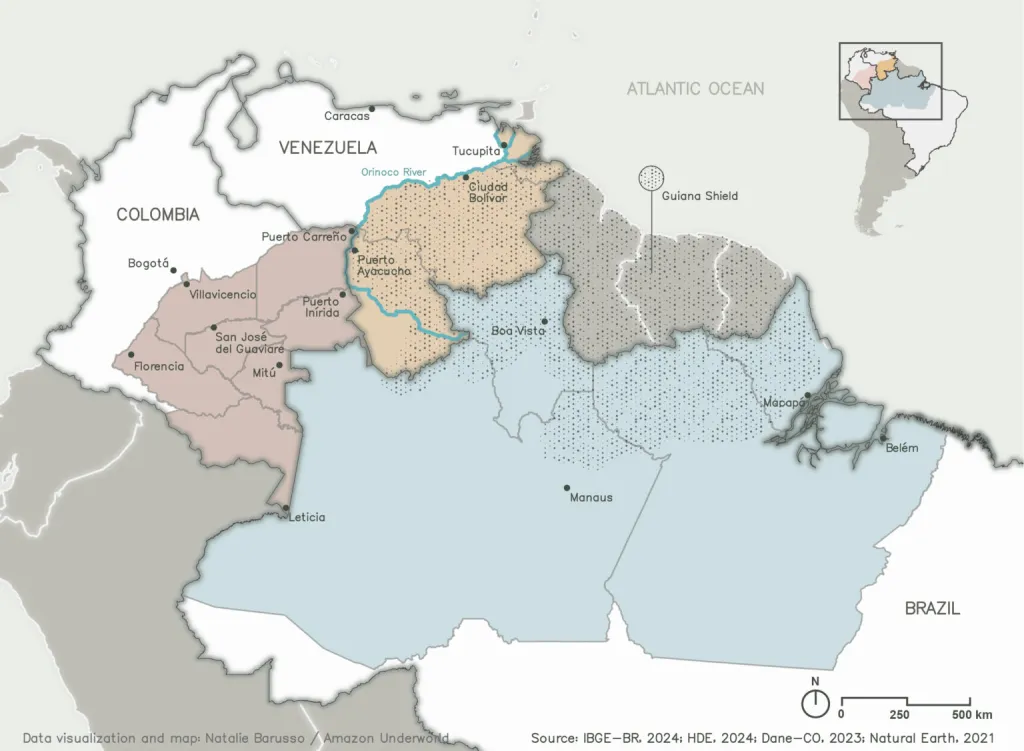
The Orinoco River divides two nations deeply impacted by each other. Colombia’s armed conflict has spread eastward into Venezuela. Irregular armed groups routinely cross the river and infiltrate Indigenous lands in the Amazon rainforest, expanding their criminal enterprises of drug trafficking and illegal mining. As violence moves in one direction, refugees flow in the other: millions of Venezuelans, nearly a third of the population, flee their country’s deep humanitarian, political, and security crisis. Many end up settling in neighboring Colombia.
Community-run mines in an area called “Pego Pego,” in Venezuela’s Bolívar state, were brutally seized in 2023, when hundreds of National Liberation Army (ELN) guerrillas took over the mines accompanied by buyers whom miners and communities describe as “Chinese.” “Months later they even brought in helicopters. Everything was chaos, they were taking the materials away,” recalled Josué*.
‘I don’t know how many wars‘
Layer upon layer of volcanic lava unfolds through the continuous movements of magma: erupting, shifting underground, solidifying, and crystallizing into a myriad of minerals and elements. The Guiana Shield, one of the Earth’s oldest continental fragments, dates back more than 1.7 billion years and contains some of the planet’s most ancient rocks. The granitic bodies embedded within them carried mineral-rich solutions that later formed metals such as tin, tungsten, tantalum, and rare earth elements. These specialized metals are essential for modern technology. Without them, the electric motor magnets, phone screens, and guided weapon systems could not function.
Why are they called “rare earth minerals”?
They are “rare,” not because they are scarce, but because of the historical difficulty of isolating and processing them. Their sources are concentrated in only a few countries (mainly China), making supply risky. They are currently hard to substitute with alternative materials and are vital for key industries: renewable energy, electronics, health care, and advanced manufacturing. They are also strategically important for national security, economic competitiveness, and technological advancement.
Millions of years of humid tropical climate and torrential rains eroded these rock formations, breaking them down into soils that concentrated heavy minerals. Rivers then carried and scattered these minerals throughout the rainforest region as we know it today.
Twentieth-century geological studies had already documented the presence of critical minerals — coltan and rare earth elements — in the border region between Venezuela and Colombia.
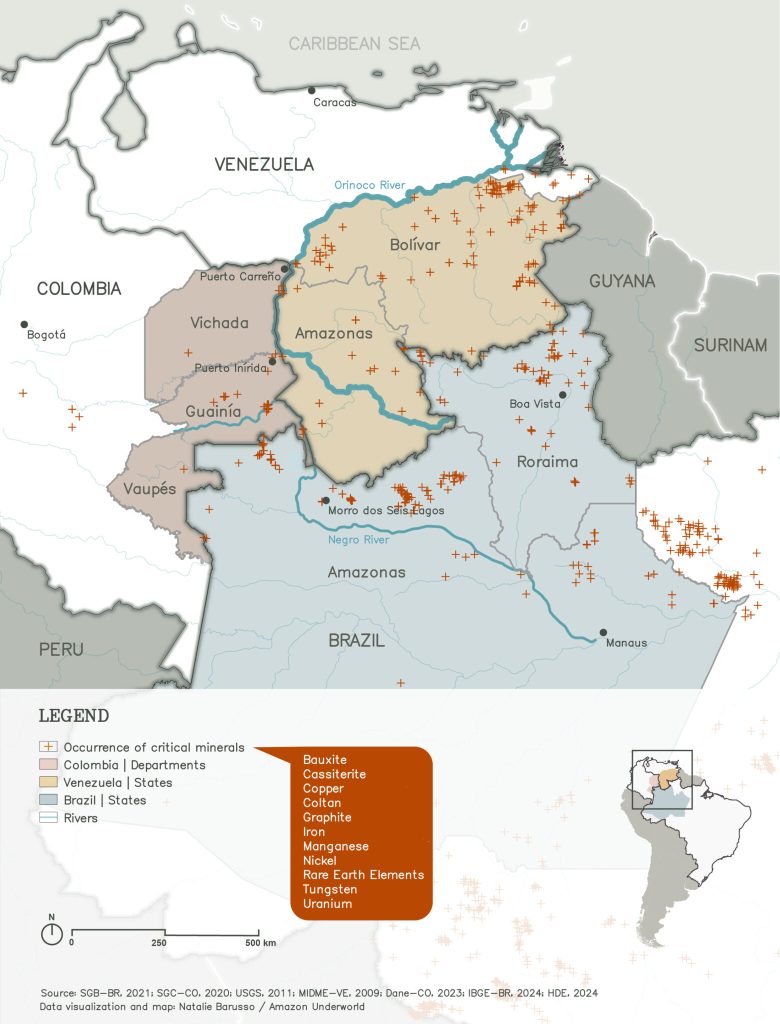
But it wasn’t until 2009 that these technical findings became geopolitical reality, when then-President Hugo Chávez announced that Venezuela possessed a “great reserve” of what he called “blue gold,” referring to coltan.
“That is a mineral over which I don’t know how many wars have been fought in Africa, because it’s a strategic mineral, among other things, used to make long-range rockets,” Chávez declared, linking Venezuela’s discovery to conflicts in other parts of the world.

Recognizing the security implications, Chávez simultaneously denounced the irregular extraction of coltan in Venezuela and its smuggling into Colombia. That same year, he deployed 15,000 National Guard personnel to the Parguaza River area in Bolívar state. “A strategic mineral called coltan has been discovered. We have taken the zone militarily because they were smuggling it to Colombia, exploiting it illegally,” he announced.
The massive military deployment near the Colombian border unsettled Álvaro Uribe’s administration in Bogotá, where little information was available about coltan deposits in the border areas. Colombia responded with sporadic seizures and promises to formalize the sector, but lacked the scientific evidence and legal framework needed for private companies to obtain mining permits.
This regulatory void created space for informal markets. Around 2010, prospectors, traders, and illegal miners moved into the area, anticipating high profits from what they saw as a new “gold rush” with coltan as its star. “At that time it was the rare earth boom, the coltan boom. Back then there was mineral trafficking in Puerto Inírida, that’s where it all began,” said Juan Guillermo García, a Colombian mining investor.
Yet the chaos in Venezuela’s mines persisted despite Chávez’s announcements. The informal cross-border trade continued for more than a decade. It wasn’t until 2016, three years after Chávez’s death, that his successor, Nicolás Maduro, signed the Orinoco Mining Arc decree, designating 112,000 square kilometers for mining development, including areas specifically for coltan extraction.
Despite these initiatives, which included the creation of joint ventures, foreign investment never materialized. Instead of recognized mining corporations or companies with experience in the sector, Colombian armed groups began taking control of Venezuela’s southern mining districts, fundamentally altering trade dynamics as buyers started appearing directly at mining sites in Bolívar and Amazonas states.
While Colombia saw little geological prospecting due to decades of armed conflict, lack of infrastructure, and high travel costs, Brazil began mapping significant deposits during its military dictatorship. The country — home to the world’s first niobium reserve, the second-largest rare earth reserve, and major cassiterite deposits — began positioning itself strategically in the critical minerals market. In 2021, then-President Jair Bolsonaro introduced the Pro-Strategic Minerals Policy to accelerate project licensing.
His successor, Lula da Silva, has since implemented a “national sovereignty” approach to assert government control while remaining open to international partnerships. His strategy rejects the colonial pattern of exporting raw materials only to buy back expensive processed products, balancing resource nationalism with global cooperation. As he puts it: “If I don’t even know this mineral and it’s already critical, I’m going to keep it for myself. Why let someone else take it?”
This policy shift materialized in January 2025 when Brazil and the United Arab Emirates signed a memorandum of understanding for potential investments of up to US$2.45 billion in Brazil’s critical mineral supply chains. This deal focused on exploration, processing, and technology transfer — part of Brazil’s broader strategy to diversify away from its heavy dependence on iron ore.
In 2025, China’s export restrictions on critical rare earth elements — imposed in April as retaliation for U.S. tariffs — have intensified global competition for alternative supply sources. While Western nations seek to reduce reliance on China, which controls 91% of rare earth refining capacity, Chinese buyers are increasingly accessing materials from regions with weak regulatory oversight — including the Colombian-Venezuelan border area.
This geopolitical pressure has created market incentives that ignore the environmental and social costs of irregular extraction in remote areas with limited state presence. The strategic importance of these materials for defense, technology, and renewable energy has opened up uncharted territories for mineral exploitation, converting 20th-century scientific discoveries into 21st-century battlefields.
*Source names have been changed for security reasons.
Opening image: A Venezuelan miner displays stones containing tin and coltan extracted from mining sites controlled by Colombian guerrilla groups in the state of Bolívar. Photo: Bram Ebus/Amazon Underworld.
Lead Researcher
Bram Ebus
Researchers
Daniela Castro, María de los Ángeles Ramírez, Emily Costa, Fábio Bispo, Hyury Potter, Karen Pedraza, Isabela Granados, Natalie Barusso.
Cover and infographics
Laura Alcina
Maps
Natalie Barusso