
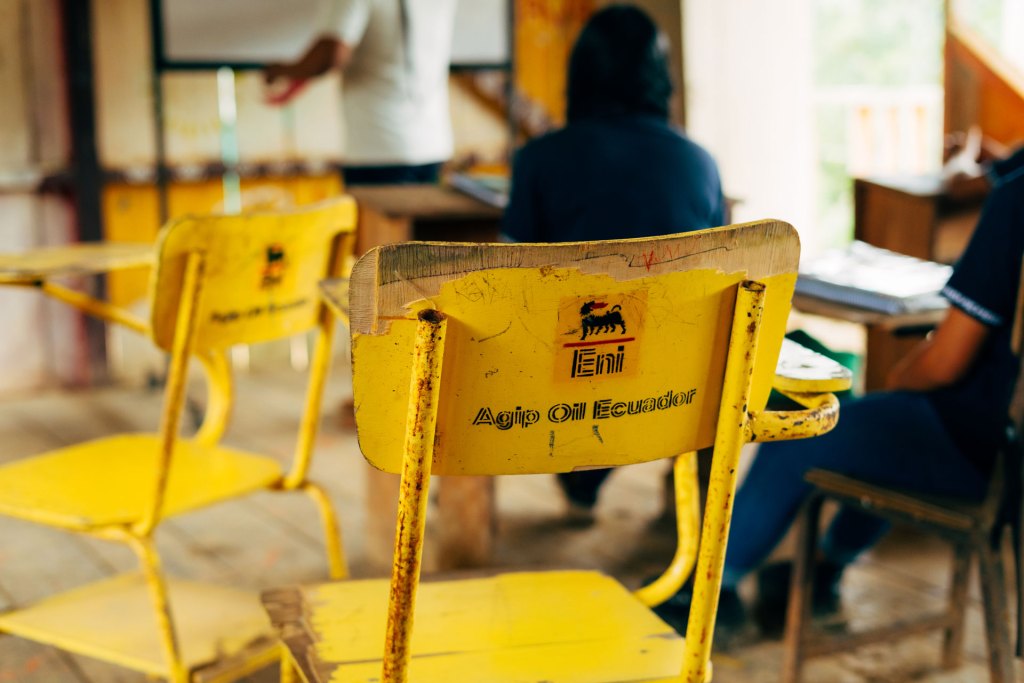
Classroom in the Piwiri community where desks have the logo of Agip Oil, the Italian oil company that operated in the region for nearly two decades.
Photo: Diego Lucero/InfoAmazonia
Over the past 30 years, the three companies that have managed Block 10, an oil extraction site in the Ecuadorian Amazon, have sought to divide local communities and increase their reliance on their corporations. However, Indigenous leaders and organizations are actively pushing back against these efforts.
By Emilia Paz y Miño and Isabela Ponce | GK
April 23, 2025
Seated in a modest gray boat, Rosa Aranda trails her fingers in the waters of the Villano River, which stretches roughly 100 kilometers through the southeastern Ecuadorian Amazon. As the vessel sails on, she maps out the villages she intends to visit over the next three days: Piwiri, Kamunwi, and Yutzuyaku.

At 45, Aranda leads Moretecocha, a commune (or Indigenous governance body) representing eight villages of the Kichwa people. Her visits serve a specific purpose: to ensure that Pluspetrol, the oil company operating in the region since 2019, is adhering to the agreements made with the local communities over the past four years.
For the company, this is Block: An oil block is a designated area within a country’s territory — either onshore or offshore — granted by the government for the exploration and production of oil and natural gas. 10—a designated area officially approved for oil exploration: Exploration is the initial phase after an oil block is granted to a company or consortium. During this stage, studies are conducted to identify viable reserves for extraction, such as seismic surveys and exploratory drilling. Unlike the production phase, there is no continuous extraction of oil or gas for commercial purposes yet.. For Aranda, it’s simply “home.”
Aranda departs Paparawa, a port at the end of a road built by Agip Oil, the Italian company that operated the oil block for nearly two decades until 2019, when Pluspetrol acquired it. Boarding a peque-peque, the grey boat named for the rhythmic chug of its engine, she begins the journey on the Villano River. The trip can take up to four hours, depending on recent rainfall.
On a sweltering and overcast October morning in 2024, Aranda arrives in Piwiri, the village she leads as president and where her brothers and other families live. Situated in Ecuador’s Pastaza province, one of six in the Amazon region, Piwiri is among 77 designated areas across Ecuador’s rainforest and coastal zones earmarked for oil exploration.
Ecuador has granted 16% of its land to public and private oil companies, according to the country’s Ministry of Energy and Mines. It is also the Latin American country with the most Indigenous lands affected by extraction. Nearly half —207 of 437— of the areas with designated oil blocks are located in Indigenous lands, covering 21,000 square kilometers.
This analysis is part of the cross-border project Every Last Drop, a journalistic collaboration uniting four media outlets from Amazonian countries to examine the effects of the oil industry in the region.
16% OF ECUADOR’S TERRITORY
is awarded to oil companies
Oil has been part of Ecuador’s history for over a century. The first well: An oil well is a hole drilled into the ground — either onshore or offshore — to access underground reserves of oil and natural gas. was explored off the coast in 1911, but it wasn’t until 1972 that it became a cornerstone of the national economy. Since then, it has remained one of the country’s main exports. However, this economic development has come at a steep cost.
The Chevron case stands out as the most emblematic, not only due to the scale of the damage but also because of the litigation’s international impact. The U.S. company, formerly Texaco, dumped more than 16 billion gallons of toxic waste in the northern Ecuadorian Amazon over four decades, until the early 1990s.
This tragedy was not an isolated event, nor is the problem confined to a single region. Between 2012 and 2022, there were 1,584 oil spills in the country, primarily due to inadequate pipeline maintenance, according to the Ministry of Environment, Water, and Ecological Transition. Presently, the nation experiences at least two spills a week.
1.584 OIL SPILLS
between 2012 and 2022
Despite this history, the administrations of Guillermo Lasso and Daniel Noboa have proposed plans to expand the oil frontier. The reserves available in the more than 7,000 wells in operation are limited, warns Fernando Santos Alvite, an oil expert and former Minister of Energy and Mines in the Lasso government. He states that estimates suggest only two billion barrels remain in the country, sufficient for another ten to 12 years of drilling. This could extend to 15 or 20 years with optimized production.
To address the depletion of reserves, the two governments have suggested expanding the oil frontier into the southeastern Amazon, in areas close to Block 10. In October 2024, the GK team, the Ecuadorian outlet of the cross-border Every Last Drop project, visited this block. Exploration continues there, despite opposition from some Indigenous groups.
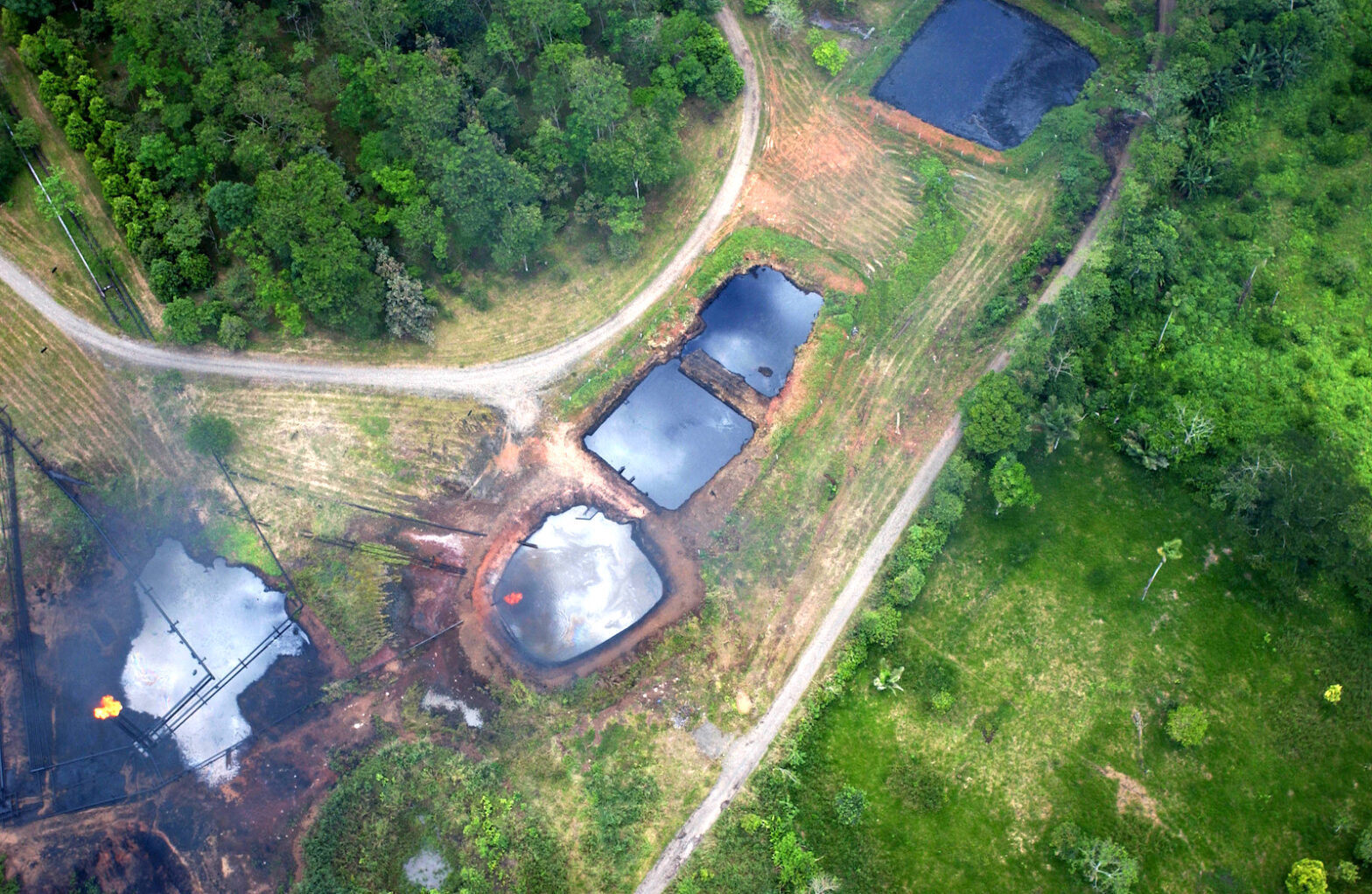
The area spans 2,000 square kilometers and produces 8,100 barrels of oil daily, as reported by Ecuador’s Ministry of Energy and Mines. This concession includes three oil fields: Oil fields are the areas where extraction takes place. They are located within a specific block and can be classified as active — when extraction is ongoing — or inactive, when operations have ceased. with a total of 30 wells already drilled. Of these, 21 are currently operational, all managed by Pluspetrol, whose concession extends until the end of 2033. The company is owned by the Rey Rodríguez family, one of the wealthiest in Argentina, but it is headquartered in the Netherlands.

Pluspetrol is the third oil company to operate in the region and the latest one with which Rosa Aranda and other leaders have had to negotiate. Block 10 was first awarded in 1987 to the American company Arco-Oriente. The following year, the company began research in the Villano field to assess the quantity and type of oil in the subsoil.
Over 35 years, the exploitation of Block 10 by companies Arco-Oriente, Agip Oil, and Pluspetrol has fueled family conflicts and divisions among Indigenous leaders. These power struggles, particularly in a region with limited access to healthcare, education, and employment, have become a focal point of research for experts like Marisol Rodríguez.
Rodríguez has a master’s degree in anthropology from the Latin American Faculty of Social Sciences (FLACSO) in Quito and has been studying Block 10 for seven years. She explains that when Arco-Oriente arrived in the region, its employees tried to corrupt the Indigenous leaders by offering them money that was ostensibly to benefit the whole community. For those who resisted, says Rodríguez, the strategy included trips to the coastal city of Guayaquil, one of Ecuador’s main tourist ports. It was in this way, according to the researcher, that a “rupture of the social fabric of the communities from the inside out” began.
Leonardo Viteri is also familiar with the oil companies’ practices. With almost 40 years of experience in the region, he has led various Indigenous organizations and participated in negotiations with the three companies that operated in Block 10. Viteri recalls the arrival of Arco-Oriente took place “without any kind of consultation, without any kind of agreement.”
Arco-Oriente had been conducting seismic exploration and drilling exploratory wells for just a year when conflicts with local communities arose. A FLACSO study highlighted these disputes swiftly assumed “very political” contours, coinciding with a time of increased mobilization to defend the rainforest.
Pastaza communities, mindful of the oil exploration impacts in neighboring Napo province, sought to avoid a similar fate. The study documented inadequate toxic waste treatment, noise pollution from dynamite explosions, and a rise in skin diseases, among other issues.
In 1989, the now-defunct Pastaza Indigenous Peoples’ Organization (OPIP) led protests against oil exploration in their region. These demonstrations culminated in an eight-day meeting between Indigenous leaders, oil company representatives, and officials from the government of Rodrigo Borja (1988-1992). The resulting Sarayaku Accords marked the first attempt to restrict activity within the lands designated as Block 10.
The accords outlined four key demands, Viteri said. It paved the way to suspending exploration, formally recognizing the Indigenous territories, repairing environmental damage, and establishing a dialogue between the state, the company, and the Kichwa people of Pastaza. “But after the representatives left,” he recalled, “the government didn’t honor the agreement, and the company continued exploration.”
In 1990, a new protest erupted on the outskirts of Villano to try and stop Arco-Oriente’s operations near the recently established Villano oil field. According to Viteri, roughly 600 protestors marched into what they discovered became a militarized zone. They also soon learned that several of their leaders had been co-opted by the company, signing agreements that ensured Arco-Oriente could continue operating.
Antonio Vargas, a prominent Indigenous leader in Ecuador and two-time president of the OPIP, recalls a time of greater unity. In Puyo, the provincial capital, Vargas notes that in the early 1990s, OPIP encompassed the entire Kichwa population. However, with the arrival of Arco-Oriente, three villages splintered from the organization, opting to negotiate directly with the company in exchange for education and healthcare services.
In a low, somber voice, Vargas summed up the impact of that moment: This is how the Kichwa of Pastaza entered the “oil age.”
Almost a decade later, in late 1999, Arco-Oriente left the country. The following year, Agip Oil assumed control of Block 10. The new operator continued the practice of dividing the Indigenous population, the Indigenous leaders said, and signed contracts to improve the communities’ access to healthcare with organizations that were not recognized by OPIP.
The Association for the Indigenous Development of the Amazon Region (Asodira), founded in the early 2000s by local residents, was among these groups. Asodira’s sole purpose was to serve as a legal intermediary, channeling resources from the oil company to the communities. According to founding member Ector Mayancha, the association’s role was purely administrative. Asodira dissolved in 2009 when the communities chose to contract directly with the company.
For over 30 years, Arco-Oriente and Agip Oil have employed specific tactics in their dealings with Indigenous communities. To understand how these negotiations continue, Rosa Aranda investigated the agreements signed with Pluspetrol, the current block operator. In Piwiri village, residents say they still await promised funds from the oil company for the construction of new peque-peques, airstrip maintenance, and to buy building materials.
Aranda wishes the oil company would leave the territory, but her current battle is to ensure adherence to existing agreements. If new wells or fields are opened, she insists that the company honors the right to prior, free and informed consultation: Free, Prior and Informed Consent is the right of Indigenous peoples and traditional communities to be consulted before any project, policy, or activity that could affect their lands, livelihoods, or rights is carried out., as guaranteed by Ecuador’s Constitution. In practical terms, this requires the state to offer transparent information and seek input from communities before approving projects on their land.
However, experts like lawyer Verónica Potes note that this right is seldom respected.
Oil companies in the role of the state
The small boat carrying Rosa Aranda gilded under a clear blue sky towards the intense green trees lining the banks of the Villano River. It was here that, just a few weeks earlier, the community of Yutzuyaku was established.
The 21 founders of the new settlement were originally residents of the neighboring village of Lipuno. Marcelo Cuji explains their relocation was due to a lack of space. Furthermore, Cuji’s brother Ricardo, who serves as the president of Lipuno, negotiated directly with Pluspetrol. According to Cuji, these decisions adversely affected his family, including his eight children.

Cuji says that Pluspetrol provides Indigenous communities with jobs primarily involving weeding and clearing obstacles near an oil pipeline. He explains that the president of each community selects the men who will work in the oil field.
The company employs workers from eight villages within the block, all appointed by their respective village presidents. They work in 15-day shifts, after which a new group of workers from other communities takes over. Salaries range from US$500 to US$575 per month, slightly above the national minimum wage.
Cuji says his children were excluded from this income-generating opportunity by his brother. Taking a sip of chicha, a traditional fermented cassava drink, he adds that this, along with his brother’s increasing estrangement, prompted his family’s departure from Lipuno for good.
Over the phone, Ricardo Cuji said Marcelo and his family were expelled from Lipuno for “inciting division and provoking violence,” and that he informed Pluspetrol of the decision. He added that he now has a good relationship with his brother and hopes he and his family will work with their new community to reach agreements with the oil company.

His son, Gabriel, now president of the newly founded Yutzuyaku, plans to approach Pluspetrol to negotiate a new agreement and secure work for the community.
Aranda shares the chicha with Marcelo and Gabriel. As the president of Moretecocha, she announces plans to integrate the new community into the association that currently unites eight villages, seven of which have already signed agreements with the oil company.
Disputes stemming from conflicts over oil company activities in Block 10 have frequently divided families, according to research by Guillaume Fontaine, a public policy professor at FLACSO. Fontaine notes allegations of irregularities in the prior consultation process with communities in the Villano Norte sector fueled these conflicts.
Alexandra Almeida, who has collaborated with communities in Block 10 through the organization Acción Ecológica, says in the Amazon, successive governments have overlooked the basic needs of Indigenous populations, including health, education, housing, and sanitation. She states that what “should be the responsibility of the state” often falls to companies to provide.
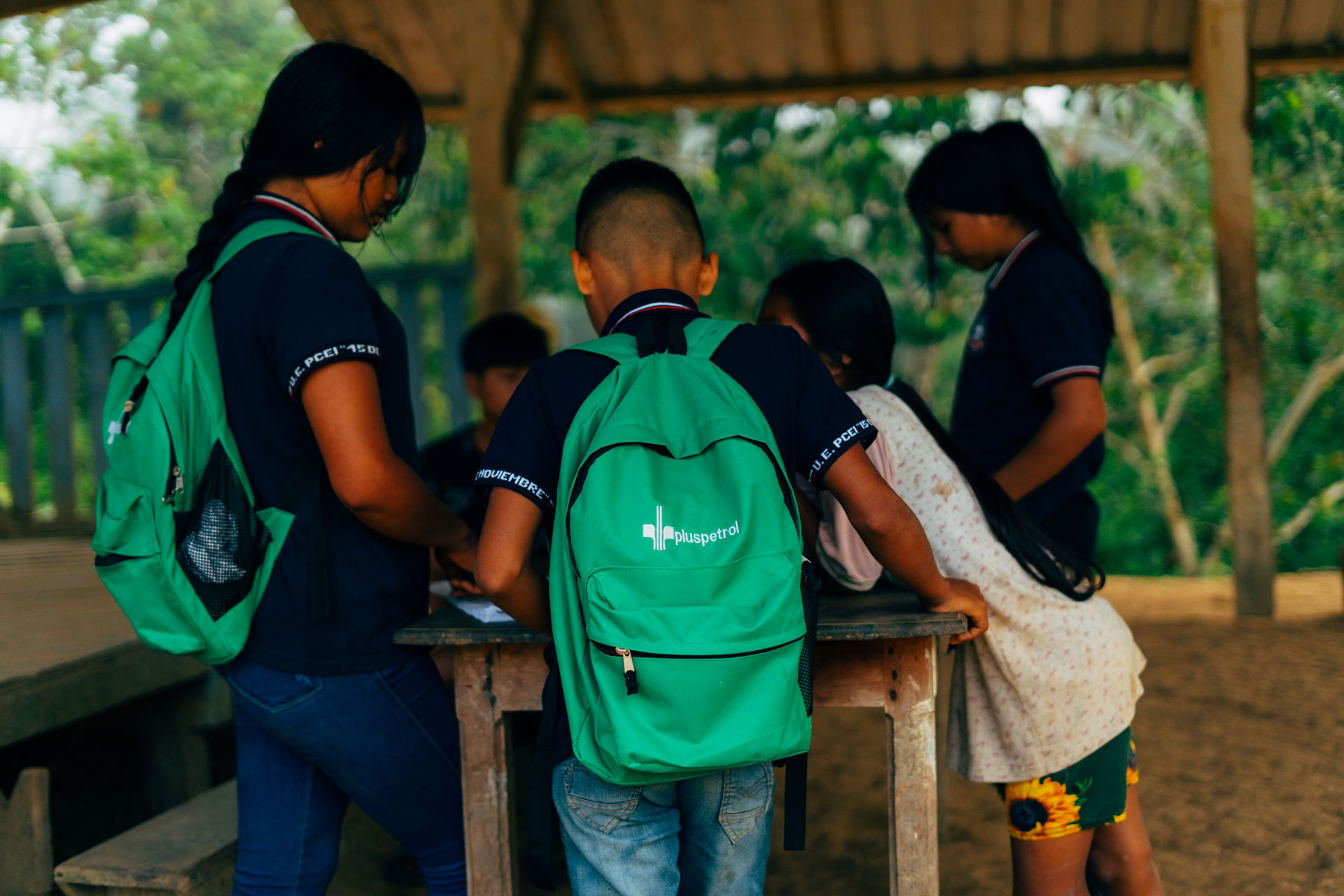
Oil companies play a vital social role beyond job creation, extending their reach into education. In the Piwiri community school, where worn and cracked wooden walls enclose the classrooms, students sit at yellow metal desks bearing the Agip Oil logo. Their green or blue backpacks, along with notebooks, pens, and snacks, are supplied by Pluspetrol.




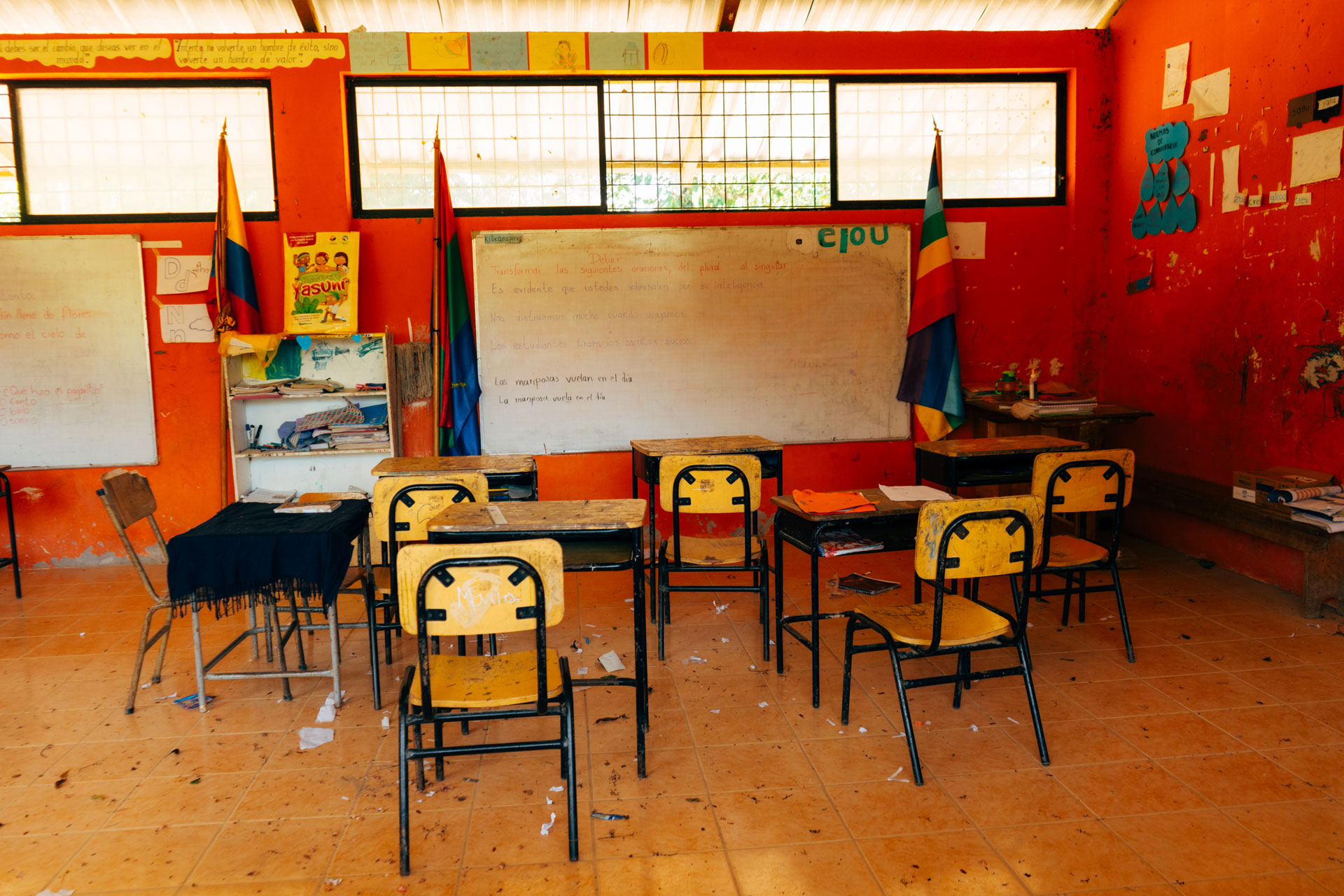
Ecuador’s Ministry of Education funds only one teacher, Leonidas Vargas. A member of the Achuar Indigenous group, Vargas teaches 16 students aged 13 to 20. His curriculum includes mathematics, Spanish, literature, natural sciences, social studies, and English.
Classes rotate to accommodate all students. The last years of elementary school attend Mondays and Wednesdays; older students attend Tuesdays and Thursdays. Fridays are reserved for physical education, arts, and content review.
“Children who finish elementary school don’t find it easy to continue their studies,” says Vargas. “I have students aged 19 and 20 who can’t read, nor can they count.”

Vargas says students’ parents pay a monthly fee of US$5. However, if payments are delayed, the school is temporarily closed. According to the teacher, this occurred in Piwiri in 2024.
In Kamunwi, a 15-minute boat ride from Piwiri, the situation is much the same. Irma Andy, the sole teacher, says, “We can’t work.” She explains educational materials are not fully available for her students, forcing her to print them herself when she travels home. While the Ministry of Education provides textbooks, these don’t fully address the students’ needs.
Andy divides the class into three groups and herself teaches aesthetic culture, physical education, math, Spanish, literature, natural sciences, social studies, Quechua and English.
Andy and fellow community members warmly greet Rosa Aranda at Kamunwi’s community center—a spacious, airy structure with high ceilings and a roof of dried palm leaves. At its center, a wooden table and benches serve as a gathering place for residents. Aranda exchanges pleasantries, cracks jokes, and seamlessly switches between Quechua and Spanish. She accepts a cup of chicha offered to her, then gets to the point: Any updates on the oil company? Have they reached out? Has anyone come to visit you lately?

The president of the Kamunwi community, Camilo Tapui, stated that Pluspetrol had pledged to send U$10,000 for building a peque-peque, along with funds for purchasing clothes and construction materials. However, he reported that no money has been received.
Children walking past the community center carry backpacks sporting the Pluspetrol logo. These communities often have only one toilet, dilapidated school furniture, scarce jobs, and a subsistence economy. A new backpack, therefore, does not go unnoticed.
Health workers in the hands of oil companies
Pluspetrol provides more than just backpacks and school supplies to residents of Block 10. During another visit, Rosa Aranda spoke with a health worker who, citing security concerns, requested anonymity. She works for Hanaska, which is a contractor for Pluspetrol.
The health agent has basic nursing knowledge, but her main role is to visit homes to talk about preventing child malnutrition, alcoholism and suicide. She also advises residents on hygiene and water quality to prevent illness, using printed material sent by Hanaska.
The agent advises mothers to remind their children to wash their hands before eating and bathing. However, the children use untreated water collected from a stream and distributed through hoses for this purpose. They also bathe in the river. In recent years, some mothers have reported that after bathing, “little balls” appear on their children’s skin, followed by itchy white spots. They believe the issue is linked to contamination from oil activities.
But research cannot yet prove this is the cause. Skin lesions on a child in one of the communities, for example, could be a fungal infection resulting from the hot, humid climate.
Every day, the health worker observes the individuals who visit her clinic—a modest brick structure equipped with just a stretcher, an aging table, and a shelf holding an oxygen mask.

Along with all 19 other health professionals in Block 10, she lacks authorization from the Ecuadorian Ministry of Health to prescribe medication. Her duties are limited to making recommendations and, primarily, completing forms—all bearing the Pluspetrol logo.
If there is an emergency, she calls Hanaska to ask for the patient to be taken to the nearest health center, which is an hour away in a peque-peque. If the patient needs more comprehensive care, the journey continues for another two or three hours by car to Puyo.
“I always say, ‘You have to take really good care of yourself, because we’re far from [medical care],’” she says. She earns a monthly salary equivalent to Ecuador’s minimum wage.
Another employee, who asked not to be identified, said he assists residents with solid waste management and prepares biweekly reports on community perceptions of the oil company, which are discussed in meetings with company representatives.
Pluspetrol, in response to this report, said that it employs 552 rotating workers from communities in Block 10 through contractors, including the health agent.The oil company also hires community companies. For the maintenance and cleaning of the Villano-Pandanuque road, Asovillano was selected. This company is composed of professionals from the Ilipi community, located within the area influenced by the Villano field.
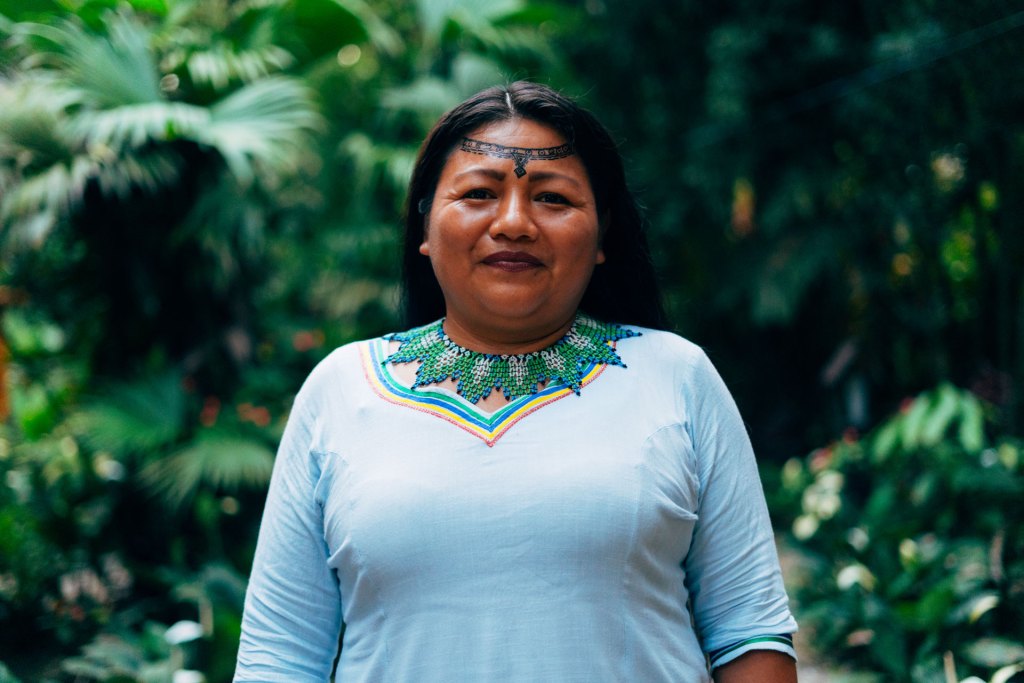
Doris Gualinga, former president of Asovillano, says women comprise 95 percent of the team. Each day, they use machetes to clear vegetation along a road that connects the local communities. Like the men working on the pipelines, these women live in villages that have agreements with Pluspetrol.
An analysis conducted by the Every Last Drop project, utilizing forest cover data from the University of Maryland’s Global Forest Change, reveals a pattern of deforestation along the roads leading to the oil fields in Block 10. This was especially pronounced in 2022, when 563 square kilometers were cleared within the block. Overall, from 2001 to 2023, deforestation in the block amounted to 3,622 square kilometers.
Rosa Aranda says she has tried to discuss with Doris Gualinga her relationship with the oil company, but the former president refuses to talk. While Aranda is unwilling to work with companies affiliated with Pluspetrol, she criticizes the unequal distribution of jobs within the communities. She cites the Cuji brothers, alleging job appointments favor certain families.
Aranda obtained a 2022 document from Pluspetrol’s community affairs directorate, barring her from selection processes. It is, she says, retaliation for her work in the region.
Aranda claims this is not the first time they have faced retaliation from an oil company. In 2018, a group of women staged a protest in Quito to advocate for prior consultation and to call for an end to oil exploration in the Ecuadorian Amazon. Among the protesters were Salomé Aranda and Noemí Andy, the sister and wife of Rosa’s brother Armando.
Armando, at the time a health worker contracted through an outsourced company for Agip Oil, reported being pressured to resign due to his family’s participation in the protest. He refused. Agip subsequently terminated the contracts of all health professionals in Block 10. While most were rehired days later, Armando was not.
These cases have prompted Indigenous communities to include employment protections into their agreements with oil companies. According to Pluspetrol, 17 contracts have been signed with 28 communities in the Villano field. One of them, signed with the Huito people, stipulates that at least 70% of the labor hired must be local.
Another agreement, signed in 2021 with the municipality of Moretecocha, prioritizes hiring local professionals for roles in health and maintenance. However, Aranda emphasizes the need for ongoing oversight to ensure adherence to this commitment.
Pluspetrol, facing conflicts over its negotiations with pro-exploration leaders, told this report its respect for the communities’ “organizational structure” and “autonomy in choosing leaders.” The company also maintained that its hiring processes for the Villano field are “open and transparent,” guaranteeing opportunities for all residents of impacted areas.
Imminent opening of new fields
In 2022, members of the now-defunct OPIP formed Pakkiru, an organization currently representing 16 Kichwa Indigenous communities and associations in Pastaza. Pakkiru’s president, Luis Canelos, aims to unify these communities to oppose oil drilling.

Canelos acknowledges that some communities don’t belong to Pakkiru due to their support for oil drilling. He points out the challenge arises when Indigenous people inquire about the organization’s offerings in exchange for opposing oil extraction: “We are not in a position to provide for the needs not met” by the state, he says.
Internal divisions have plagued more than just Pakkiru. For decades, the Association of Indigenous Communities of Arajuno (ACIA) presented a united front against oil companies operating in its territory, also within Block 10. In 2023, ACIA was superseded by AKAT, which now represents 27 communities surrounding Oglán, an inactive field within the block.
Diana Tanguila, wife of Canelos and president of AKAT from 2021 to 2023, claims she faced pressure to sign an agreement with Pluspetrol during her tenure. She resisted. Shortly after she left the position, her successor, Patricio Vargas, signed the contract. Vargas was contacted at least ten times for this report but declined to comment.
Tanguila says most AKAT members now believe reopening the Oglán camp is the best option for the communities. She expects the proposal will pass if a prior consultation occurs.
Oglán, however, is not the only oil field poised for exploitation in the coming years in the Ecuadorian Amazon. President Daniel Noboa is interested in launching a new round of bidding for the sector. This expansion is targeting the southeastern Amazon, as announced by then-Deputy Minister of Energy and Mines María Cristina Mogollón in October 2024.
Pluspetrol intends to activate the Siccha field, also within Block 10. The project’s environmental impact study indicates potential consequences during construction, including significant landscape alteration, soil compaction, elevated noise levels, and increased turbidity in adjacent waterways. Moderate impacts, such as diminished air quality and accelerated erosion, are also anticipated.
The study also identified social conflicts, particularly clashes of interest between members of two communities. It described “conflict and fragmentation within the community’s organizational structure and social organizations, stemming from differing opinions about activities conducted in areas affected by the project.”
Since 1967, when Texaco drilled the first commercial well in Ecuador’s northern Amazon, oil companies have shown little concern for sustainable practices or community autonomy, says Leonardo Viteri. He argues their business strategies have consistently fostered community dependence by offering only short-term benefits.
When the oil runs out, Viteri warns, “the population will have no alternative.” The risk is that continued drilling will devastate forests, affect the viability of traditional means of subsistence such as hunting and fishing, and plunge communities into deeper poverty.

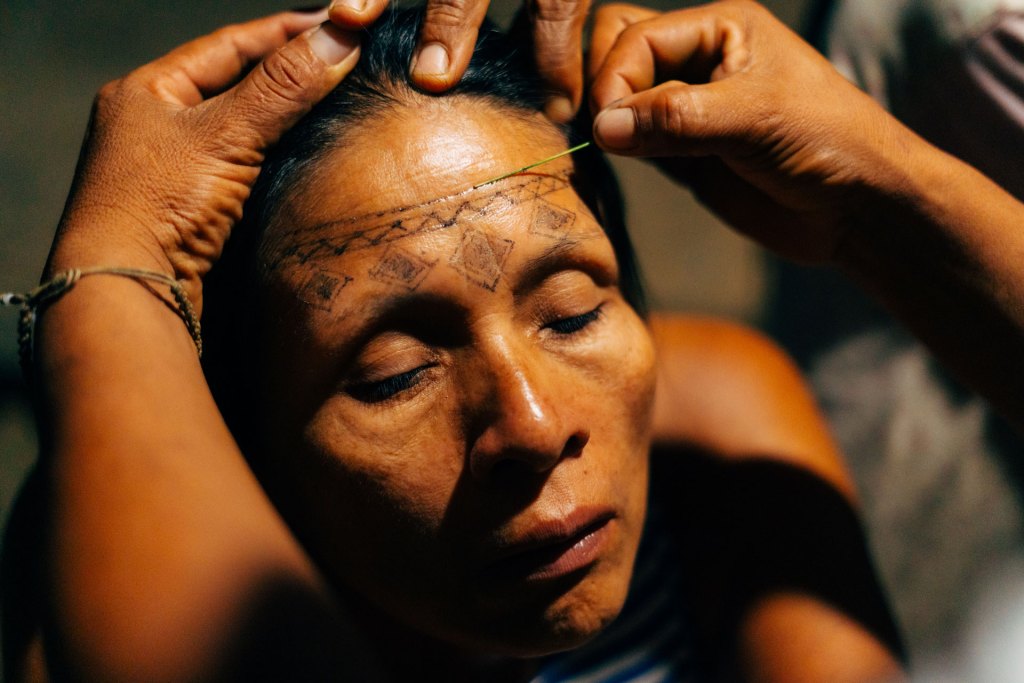
Women from the community gather in the communal house to talk and share a meal, while one of them paints the face of Rosa Aranda, president of Piwiri.
Photos: Diego Lucero/InfoAmazonia
Rosa Aranda refuses to accept this fate. A day after visiting the communities, she established herself in a small, makeshift office in an old house in the Amazonian town of Shell, named after the Anglo-Dutch oil company that arrived in Ecuador in the 1930s.
Facing a daunting to-do list, she prioritized collecting the oil company’s debt to Kamunwi, finding a way to include Yutzuyaku in the agreement, and preparing for her trip to Cali for the COP16 biodiversity conference in late October, among other seemingly endless demands.
This report is part of the special series Every the Last Drop, produced with support from the Global Commons Alliance, a project sponsored by Rockefeller Philanthropy Advisors.